
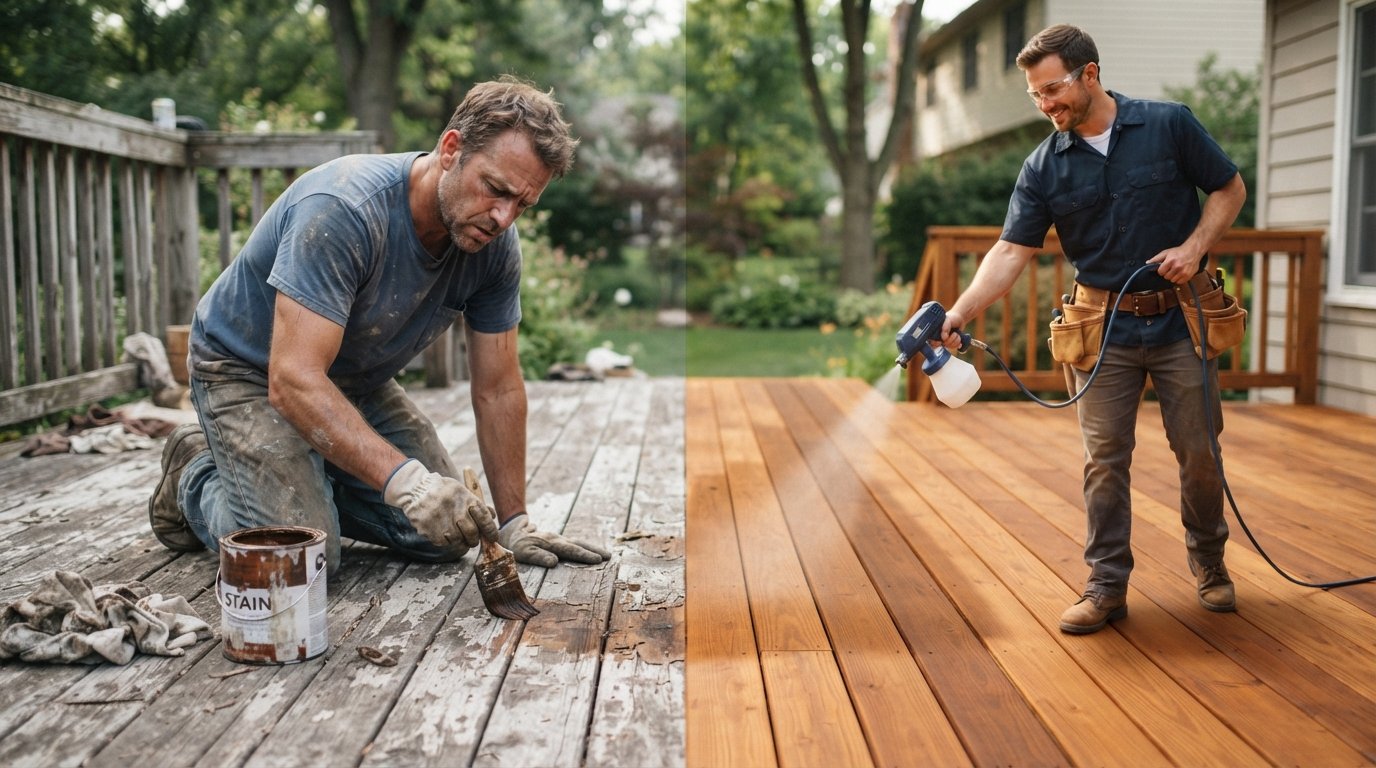
DIY vs Professional Deck Staining Cost Comparison
Weigh the true costs of DIY vs professional deck staining, including materials, time, and long-term value, to choose the best option for your home.

By Sarah Thomas
Learn more about Deck Staining and Sealing for guides, costs, and what to expect.
Compare Deck Staining and Sealing Pros Near You

Enter your ZIP code to compare top-rated local professionals and request free quotes.
Your deck has taken a beating all year. Sun, rain, snow, and foot traffic have left it looking tired and gray. A fresh stain can transform it back into the inviting outdoor space you love. But when you start pricing the project, you hit a big question: should you do it yourself or hire a pro? The answer often comes down to money. This is where a clear DIY vs professional deck staining cost comparison becomes essential. The difference is not just about the price of stain. It involves your time, your skill level, and the tools you already own. Understanding the true costs on both sides will help you make a smart decision for your home and your wallet.
Many homeowners assume DIY is always cheaper. That is true in some cases, but not all. A professional might cost more upfront, yet they bring speed, efficiency, and warranties that protect your investment. On the other hand, a careful DIY job can save you hundreds of dollars, especially if you already have the necessary equipment. The challenge is being honest about your own abilities and how much your weekends are worth. Let us break down both paths so you can see the real numbers and hidden trade-offs.
Understanding the Real Costs of Staining Your Deck
Before comparing DIY and professional options, you need a baseline. A standard 200 to 300 square foot deck is the most common size for residential homes. The total cost of staining that deck depends on several factors: the type of stain you choose, the condition of the wood, local labor rates, and whether the surface needs extra prep work. For a professional, the average price range is between $450 and $900 for a deck of this size. That figure usually includes cleaning, light sanding, and two coats of stain. For larger decks, expect to pay $1,200 or more.
DIY costs are trickier to pin down because they vary wildly based on what you already own. If you have a pressure washer, a paint sprayer, and basic tools, your out-of-pocket cost might be only $100 to $200 for stain and supplies. But if you need to rent equipment or buy everything new, that number can jump closer to $400 or $500. The real cost comparison, then, is not just about the sticker price. It is about your time and the quality of the final result.
What Is Included in a Professional Quote
When you hire a contractor, you are paying for a complete service. Most professional quotes include a thorough cleaning with a deck brightener, which restores the wood's pH after power washing. They also cover sanding or scraping to remove loose fibers and old finish. Then they apply the stain with a sprayer and back-brush it by hand to work the liquid into the wood pores. This process takes a full day for a crew of two, sometimes two days if the wood is very dry or damaged.
That labor is what drives the cost. A professional also carries liability insurance and often offers a workmanship warranty. If the stain peels within a year due to poor application, they come back and fix it at no charge. That peace of mind is a real financial value. In a DIY vs professional deck staining cost comparison, you must weigh that protection against the potential cost of redoing a failed DIY job.
DIY Costs: A Detailed Look at Supplies and Equipment
If you decide to tackle the job yourself, your first step is a trip to the hardware store. The supplies list is longer than you might think. You need stain, of course, but you also need a cleaner, a brightener, a pump sprayer, rollers, brushes, drop cloths, painter's tape, and a respirator or mask. A high-quality exterior stain costs between $40 and $80 per gallon. A typical deck takes 2 to 3 gallons, so the stain alone can reach $240. The other supplies add another $50 to $100.
Then come the tools. If you do not own a pressure washer, you can rent one for about $60 to $100 per day. A paint sprayer rents for $80 to $150 per day, though many homeowners use rollers and brushes instead to save money. If you choose the roller method, budget for a few extra roller covers because they wear out quickly on rough wood. Here is a realistic breakdown for a 250 square foot deck without existing tools:
- Stain (2.5 gallons at $60 each): $150
- Deck cleaner and brightener: $40
- Paint tray, rollers, brushes, and tape: $35
- Pressure washer rental: $80
- Safety gear and misc supplies: $30
That brings your total to roughly $335. If you already own a pressure washer and a sprayer, your cost drops to about $200. But do not forget the hidden cost of your time. A thorough DIY job takes two full weekends. The first weekend is for cleaning, scrubbing, and letting the wood dry. The second weekend is for staining. If your time is worth $25 an hour, that is 16 hours or $400 of your labor. Suddenly the professional quote of $600 to $800 does not look so extreme.
Professional Costs: What You Pay For and Why
Professional deck staining is priced per square foot, with most contractors charging between $2 and $4 per square foot. That rate includes labor, materials, and cleanup. In regions with a higher cost of living, the price can reach $5 per square foot. For a 250 square foot deck, that means $500 to $1,250. The wide range depends on the condition of your deck and the type of stain you select. Solid stains typically cost more than semi-transparent because they cover more surface and require extra coats.
When you pay a professional, you are buying expertise. A seasoned contractor knows how to read weather forecasts and can time the application to avoid rain. They understand that wood must be completely dry for 24 to 48 hours before staining. They also know which stain brands perform best on your specific type of lumber, whether it is cedar, pine, or composite. Mistakes in any of these areas can lead to peeling, blotching, or mildew growth. Correcting those mistakes later costs more than the original job.
Another advantage is speed. A professional crew can finish a standard deck in one day. That means no lost weekends for you and no risk of the wood sitting unprotected while you wait for good weather. They also bring commercial-grade sprayers that apply a more even coat than a hand roller. Finally, most pros will move your furniture and potted plants, and they will protect nearby siding and windows. That is a significant convenience that many homeowners overlook in the cost equation.
Long-Term Value: Which Option Saves You More Over Time?
The immediate price difference between DIY and professional is clear, but the long-term value is harder to calculate. A properly stained deck should last 3 to 5 years with semi-transparent stain and 5 to 7 years with a solid stain. The key word is "properly." If you rush the prep or apply stain over a damp surface, your finish may fail within a year. Then you are back to square one, buying more supplies and spending more weekends scraping off the old stain.
Professionals often use premium products that are not available at big-box stores. These stains contain more resin and UV blockers, which means better protection and a longer lifespan. They also apply a second coat after the first one dries, which many DIYers skip to save time. That second coat is what gives the deck a uniform color and adds durability. Over a 10-year period, a deck that is professionally stained every 4 years may actually cost less than a deck that is DIY-stained every 2 years because of failures.
On the other hand, if you are a meticulous person who follows instructions well, DIY can deliver excellent results. The money you save can be put toward a nicer stain or a new deck chair. The key is to do it right the first time. That means cleaning the deck with a specialized product, not just water. It means sanding spots that are rough or gray. It means applying thin, even coats and waiting the full drying time between them. If you can commit to that process, DIY is a legitimate way to save $200 to $600.
Factors That Can Tip the Scale
Every deck is different, and some situations clearly favor one option over the other. If your deck is new and the wood is still in great shape, a DIY project is very manageable. New wood does not need heavy sanding or stripping. You can focus on cleaning and staining. If your deck is old, with peeling stain, gray wood, or visible splinters, that is a bigger challenge. Removing old layers of stain is tedious work that often requires a chemical stripper and a lot of elbow grease. In that case, a professional may be worth the extra cost because they have the tools and experience to handle difficult prep.
Weather is another factor. Staining requires 48 hours of dry weather after the initial cleaning. If your local forecast is unpredictable, a professional can be more flexible because they can schedule around the weather. They may also be able to apply stain in the early morning when the wood is cool, which is better for absorption. DIYers often stain in the afternoon when the sun is hot, which can cause the stain to dry too quickly and leave lap marks. Consider the height of your deck as well. If it is a second-story deck, working on a ladder is risky. Professional contractors have the safety training and insurance to handle elevated work, whereas a homeowner could easily get injured.
How to Decide and Get a Fair Price for Professional Work
Start by being honest about your skills and available time. If you have never stained a deck before, do a small test area first. If the result looks good and the process feels manageable, you can proceed with confidence. But if you feel overwhelmed by the prep work or worried about making mistakes, hiring a pro is a smart investment. A botched DIY job can cost more than a professional would have charged, because you will need to pay for additional stripping and reapplication.
If you decide to hire a contractor, do not just pick the first name from a search. Ask for itemized quotes from at least three local companies. Compare what each one includes in the price. Some quotes will include power washing and brightening; others will treat that as an extra. Make sure the quote specifies the type of stain, the number of coats, and the warranty. A reputable contractor will be happy to answer your questions. In our guide on when to hire a contractor, we cover the key signals that say it is time to call a pro. That resource can help you weigh your own situation against the professional standard.
For the actual comparison, create a simple spreadsheet. Write down the DIY supplies you already own and the ones you need to buy. Add the rental fees and your own hourly rate for the time you will spend. Then compare that total to the professional quotes you receive. You might be surprised to see that hiring a pro is only $200 more than doing it yourself, especially when you account for your time and the risk of mistakes. Many homeowners find that the extra cost is worth the convenience and the guarantee of a job done right.
One more consideration is the overall condition of your deck. If the wood is soft, rotting, or has loose boards, staining is not enough. You would need to make repairs first, which adds another layer of cost. A professional can assess the structure and recommend necessary fixes before staining. They can also spot early signs of water damage that you might miss. This kind of expert eye is invaluable, especially if you plan to sell your home in the next few years. A well-maintained deck is a strong selling point, and a professional finish can boost your home's curb appeal.
To get the most value from your project, focus on quality. Whether you DIY or hire a pro, use a premium stain that matches your climate. In hot, sunny areas, a UV-resistant product is essential. In wet regions, a mildewcide additive helps prevent mold. The finish you choose, semi-transparent or solid, also affects longevity and cost. Solid stains hide grain but offer better protection, while semi-transparent stains let the wood show but need more frequent maintenance. Talk to a local paint specialist or contractor about what works best in your area. They can guide you toward a product that will last, saving you money in the long run.
Ultimately, the decision between DIY and professional deck staining is personal. If you enjoy hands-on projects and have the time to do it carefully, DIY is a rewarding way to save money. If your goal is a flawless, low-maintenance finish with no risk to your free time, a professional is the better route. There is no universally right answer, only the right answer for your budget and your circumstances. And when you do choose to hire, remember that BuySellRemodel can connect you with local contractors who offer free estimates. That way, you can compare prices without any obligation and feel confident in your final choice.
Take the time to get three or four quotes before you commit. Ask about their prep process, the brands they use, and their cleanup routine. A professional should also be willing to show you examples of past work. You should not have to pay a lot for a mediocre result. A good contractor will stand behind their work with a warranty. If they hesitate to offer one, that is a red flag. On the other hand, if you decide to go the DIY route, watch plenty of tutorials and read the stain label carefully. Preparation is 80 percent of the job, so do not skip the cleaning and sanding steps. Your reward will be a beautiful deck that lasts for years, and the pride that comes from doing it yourself.
Now that you have the full cost picture, you can make a choice that aligns with your skills and budget. A small investment of time in research today can save you a lot of money and frustration later. Your deck is a valuable part of your home, and protecting it is one of the smartest maintenance tasks you can do. Whether you spend a weekend with a roller or a few hours with a pro, the result is an outdoor space you can enjoy all season long. That is a return on investment that goes beyond the numbers.