
Ductwork Sealing and Air Balancing Cost Guide
Get clear ductwork sealing and air balancing cost ranges, plus tips to verify results and avoid overspending. Call (833)-439-3727 for free local estimates.

By Cameron Howard
Learn more about Duct and Vent Repair for guides, costs, and what to expect.
Compare Duct and Vent Repair Pros Near You

Enter your ZIP code to compare top-rated local professionals and request free quotes.
Your upstairs bedrooms feel like a sauna while the basement stays ice cold, and your energy bill keeps climbing even though the thermostat never budges. These are classic symptoms of a duct system that leaks conditioned air and delivers it unevenly. Before you assume the furnace or air conditioner is failing, it pays to understand what ductwork sealing and air balancing actually involve, what they cost, and when a repair makes more sense than a replacement. This ductwork sealing and air balancing cost guide breaks down real-world price ranges, explains the difference between the two services, and shows you how to verify that the work delivered the comfort and savings you paid for.
Signs Your Ducts Need Sealing or Balancing
Duct problems rarely announce themselves with a single dramatic failure. Instead, they show up as a collection of small annoyances that homeowners learn to live with. A room that never gets comfortable no matter how you adjust the vents is the most common complaint. Others include dusty surfaces that reappear days after cleaning, a whistling or rushing sound at the registers, and monthly utility bills that creep upward without any change in habits.
Leaky ducts waste energy in a straightforward way: the air you paid to heat or cool escapes into attics, crawlspaces, and wall cavities before it reaches living spaces. The U.S. Department of Energy estimates that typical homes lose 20 to 30 percent of conditioned air through duct leaks, which is money leaking out of your budget every month. Uneven delivery is a separate but related issue. Even a perfectly sealed system can push too much air to some rooms and too little to others if the duct design or damper settings are off.
Watch for these warning signs before calling a contractor:
- Rooms that stay hot or cold regardless of thermostat settings
- Visible dust streaks around supply registers or return grilles
- Rising energy bills with no change in usage patterns
- Whistling, rattling, or whooshing sounds from vents
- Excess humidity or stale air in certain areas of the home
If two or more of these symptoms sound familiar, a professional duct assessment is worth the modest diagnostic fee. A technician can measure airflow at each register, check static pressure, and inspect accessible duct runs for disconnected joints, crushed sections, and missing insulation. That assessment becomes the foundation for an accurate quote, and it prevents you from paying for sealing work that will not solve the underlying problem.
Duct Sealing vs Air Balancing: What Is the Difference?
Homeowners often use these terms interchangeably, but they describe two different services that address two different problems. Duct sealing repairs the physical integrity of the duct system so air stops escaping. Air balancing adjusts how air is distributed through the system so each room receives the right amount. Many homes need both, and reputable contractors will tell you which one is driving your comfort complaints.
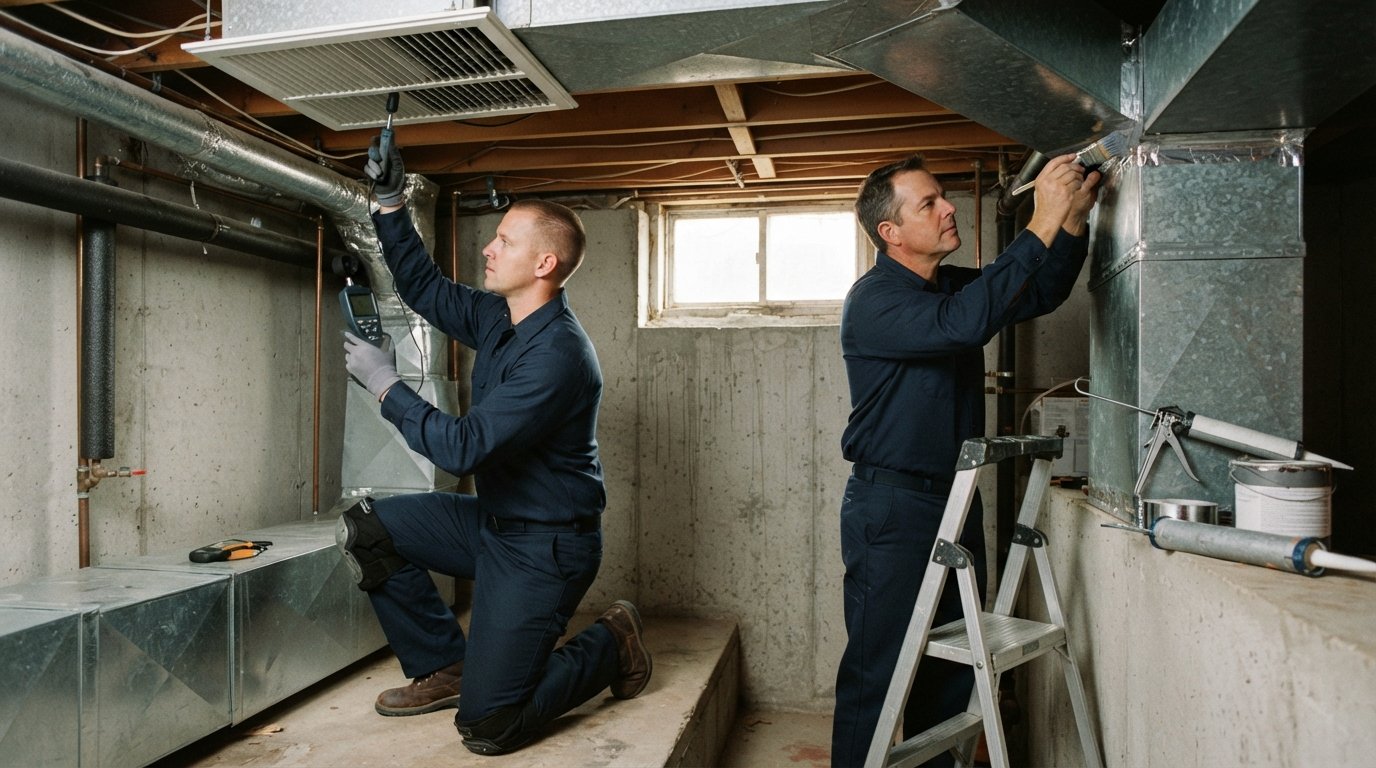
Sealing work typically involves applying mastic sealant or foil-backed tape to joints, seams, and connections. In attics and crawlspaces, contractors may also seal register boots to drywall and close gaps where duct runs penetrate framing. For homes with extensive leakage, a contractor may recommend aeroseal, a process that injects a fog of sealant particles into the duct system to coat leaks from the inside. Insulating ducts in unconditioned spaces often accompanies sealing because bare ducts lose heat through their walls even when they are airtight.
Air balancing is a measurement-driven process. A technician uses a flow hood or anemometer to measure cubic feet per minute at each register, compares those readings to the system design, and then adjusts dampers, register vanes, and sometimes blower settings to even out delivery. Balancing cannot fix leaky ducts, and sealing alone cannot fix a system that was poorly designed or has dampers stuck in the wrong position. That is why the best contractors evaluate both before recommending a scope of work.
For homeowners planning broader efficiency upgrades, it helps to think of ductwork as one piece of a larger budget puzzle. Our foundation repair cost guide follows a similar logic: diagnose the root cause first, then price the fix, so you avoid paying twice for the same problem.
Ductwork Sealing and Air Balancing Cost Ranges
Costs vary by region, home size, duct accessibility, and the severity of the leakage. The figures below reflect typical 2026 price ranges for residential work and should be treated as planning benchmarks rather than firm quotes. Always request at least two or three written estimates that specify the scope, materials, and any testing included.
- Targeted sealing of accessible joints: $300 to $800 for a focused repair of obvious leaks in an attic or crawlspace
- Whole-home duct sealing: $1,200 to $2,500, with aeroseal projects often landing between $1,500 and $3,000 depending on home size
- Duct insulation in unconditioned spaces: $800 to $2,000 for wrapping or replacing insulation on accessible runs
- Air balancing with a full airflow assessment: $300 to $800 for a straightforward single-system home
- Combined sealing and balancing package: $1,500 to $3,200 for most single-family homes
Larger homes with multiple zones, long duct runs, or difficult attic access will land at the higher end of these ranges. Homes with completely disconnected ducts or crushed flex lines may require partial replacement before sealing makes sense, which adds cost. It is also worth asking whether the quote includes pre- and post-work testing. A contractor who measures airflow before and after the job gives you objective proof of improvement, and that testing is often what separates a professional job from a quick visit with a caulk gun.
Air balancing costs can rise when the system lacks accessible dampers or when the contractor discovers that the duct layout itself is the problem. In those cases, the technician may recommend adding balancing dampers at branch takeoffs, which typically adds $100 to $300 per damper installed. Ask for this line item explicitly so there are no surprises on the final invoice.
When Duct Replacement Beats Sealing and Balancing
Sealing and balancing are cost-effective when the duct system is fundamentally sound: properly sized, mostly intact, and made of materials with remaining service life. They are a poor investment when the ducts themselves are failing. Knowing the difference protects you from spending good money on a system that will keep disappointing you.
Replacement becomes the smarter choice in several situations. Ducts made of older rigid board or failing flex with widespread tears, collapsed sections, or mold growth are usually beyond economical repair. Systems that were badly designed from the start, with undersized trunks or long runs that cannot deliver adequate airflow, will not be fixed by sealing alone. And if your home has asbestos-containing duct wrap or insulation, disturbance during sealing work creates a safety issue that requires professional abatement before anything else happens.
Full duct replacement typically runs $3,000 to $8,000 or more depending on home size, accessibility, and material choice, so the decision deserves careful thought. A reputable contractor should walk you through the inspection findings, show you photos of problem areas, and explain why repair or replacement is the better path. If a contractor recommends replacement without documenting the reasons, get a second opinion. When you are ready to compare local professionals, BuySellRemodel is a practical starting point for connecting with experienced contractors and gathering free estimates.
How to Verify the Work Delivered Results
You should not have to take improved comfort on faith. Professional duct work includes measurable outcomes, and a good contractor will document them. Before the job begins, ask for baseline readings: airflow at each register, static pressure, and if possible a duct leakage test. After the work is complete, request the same measurements so you can compare.
- Review the before-and-after airflow readings to confirm each room moved closer to its target cubic feet per minute.
- Check the leakage test results if sealing was performed; reduced leakage should be documented as a percentage improvement.
- Walk the home on a hot or cold day and verify that the problem rooms now hold temperature within a degree or two of the thermostat setting.
- Compare utility bills across two or three billing cycles against the same months from the prior year, adjusting for weather differences.
Give the system a few weeks before judging energy savings, since weather variation can mask or exaggerate short-term results. If comfort has not improved and the contractor cannot show measurement data supporting the work, you have grounds to request a return visit. Most reputable companies warranty their sealing work for at least a year, and some offer longer coverage on aeroseal projects.
Finally, keep your documentation together: the inspection report, the proposal, the post-work measurements, and the warranty terms. If you sell the home, that paperwork demonstrates a maintained and efficiency-conscious HVAC system, which is a small but genuine selling point. For homeowners managing a broader renovation budget, treating ductwork as a planned efficiency upgrade rather than an emergency repair almost always produces better decisions and better pricing.
Ductwork sealing and air balancing are among the most cost-effective comfort upgrades available to homeowners, provided the diagnosis is right and the work is verified. Start with a professional assessment, compare written quotes that include testing, and insist on before-and-after measurements. Do that, and you will know exactly what you paid for and why your home finally feels the way it should.