
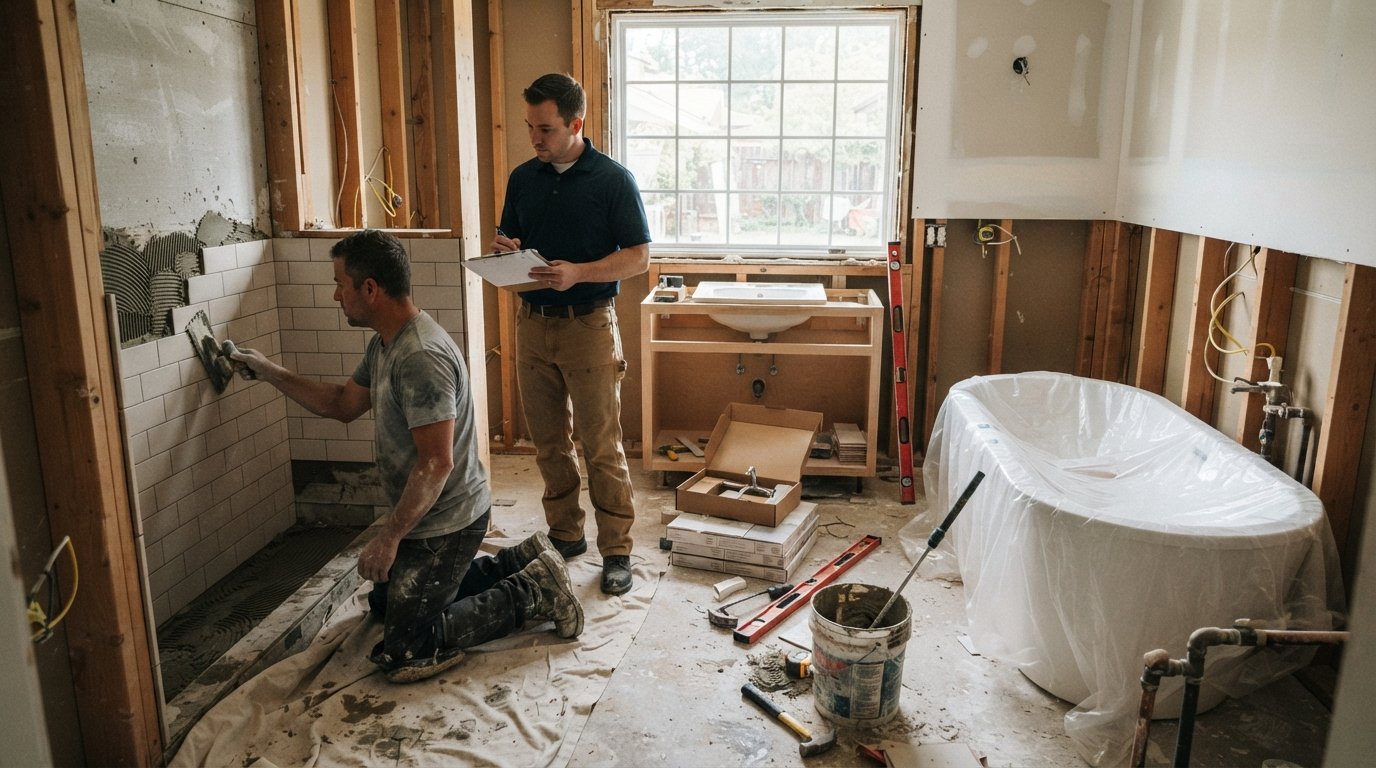
A Realistic Bathroom Remodel Timeline Start to Finish
Get a realistic timeline for a bathroom remodel start to finish, from demolition to final walkthrough. Call 8334393727 for free local estimates.

By Ethan Owens
Learn more about Bathroom Remodel for guides, costs, and what to expect.
Compare Bathroom Remodel Pros Near You

Enter your ZIP code to compare top-rated local professionals and request free quotes.
Most homeowners start a bathroom remodel believing it will take three or four weeks. Then week six arrives, the tile setter is waiting on a backordered vanity, and dinner is still happening at the kitchen sink. The gap between the timeline you were promised and the one you actually live through almost always comes down to two things: hidden conditions behind the walls and decisions that were never finalized before demolition began. Understanding the true sequence of a bathroom remodel, phase by phase, is the single best way to keep your project on schedule and your budget intact.
Below is a realistic timeline for a bathroom remodel start to finish, based on how full gut renovations, partial updates, and cosmetic refreshes actually unfold in real homes. You will see where the time goes, which phases overlap, and where projects typically stall. You will also learn how to compress the schedule without cutting corners, and how to tell whether a contractor's promised timeline is honest or optimistic.
Why Bathroom Remodel Timelines Vary So Much
A bathroom remodel is not one project. It is five or six trades sharing a room the size of a walk-in closet. Plumbing, electrical, waterproofing, tile, cabinetry, glass, and paint all have to happen in a specific order, and each one depends on the last. That is why the same bathroom can take two weeks for one homeowner and four months for another.
Three variables drive most of the difference. The first is scope: a cosmetic refresh that swaps fixtures and paint moves fast, while a full gut that relocates the drain and adds a curbless shower takes far longer. The second is permit and inspection timing, which varies significantly by city and can add days or weeks depending on how busy the local building department is. The third is material lead time, which has become the biggest wildcard in remodeling. A stock vanity might ship in three days; a custom vanity or a specific imported tile can take six to twelve weeks.
There is also the human factor. Every change order, every indecisive moment at the tile showroom, and every "let's just move the light" conversation adds real calendar days. Contractors who build in decision deadlines and material buffers finish on time. Homeowners who treat the schedule as flexible usually watch it stretch.
The Full Timeline, Phase by Phase
Here is how a typical full bathroom remodel (roughly 40 to 70 square feet, gut renovation, no layout changes) actually plays out. Times assume one crew working steadily and materials arriving on schedule.
- Design and planning (1 to 3 weeks): Finalize layout, fixtures, tile, and finishes. Secure permits if required. Order long-lead items now.
- Demolition (2 to 4 days): Remove old fixtures, tile, drywall, and flooring. Uncover hidden water damage or outdated wiring.
- Rough plumbing and electrical (1 to 2 weeks): Move or replace supply lines, drains, and vents. Run new circuits, GFCI outlets, exhaust fan, and lighting.
- Inspections (1 to 5 days): Rough-in inspection must pass before walls close. Scheduling can add waiting time.
- Insulation, drywall, and waterproofing (1 to 2 weeks): Hang and finish drywall, then apply cement board and a waterproof membrane in wet areas.
- Tile work (1 to 2 weeks): Floor tile, shower walls, niches, and grout. Drying time between coats matters.
- Fixtures and cabinetry (3 to 7 days): Set the vanity, toilet, sink, faucet, shower trim, and lighting.
- Countertops and glass (1 to 3 weeks): Template, fabricate, and install stone or quartz. Measure and install shower glass.
- Paint, trim, and punch list (3 to 7 days): Final paint, caulk, hardware, and walkthrough corrections.
Add it up and a full gut remodel lands between six and twelve weeks of active work, with eight weeks being a reasonable middle estimate when nothing goes wrong. That last clause matters. A single failed inspection or a delayed vanity can push the total past three months.
Partial remodels move faster. If you are keeping the layout, the tub, and the tile, and only replacing the vanity, toilet, flooring, and paint, you are looking at two to four weeks. A pure cosmetic refresh (paint, mirror, light fixture, hardware) can finish in three to seven days.
Where Bathroom Remodels Actually Lose Time
Knowing the phases is one thing. Knowing where they break is what saves your schedule. In practice, five issues account for most delays.
- Hidden damage: Rotted subfloor, mold behind tile, or corroded pipes discovered during demolition.
- Material backorders: Tile, glass, and custom vanities are the usual culprits.
- Inspection scheduling: A two-day wait can become a ten-day wait in busy jurisdictions.
- Change orders: Every mid-project decision resets part of the sequence.
- Trade stacking: When the plumber and electrician both need the same small room, one waits.
The pattern is clear: delays cluster around the invisible parts of the project, the ones you cannot see in a mood board. That is why experienced contractors front-load decisions and order materials before demolition starts. It is also why a contingency budget and a schedule buffer are not pessimism; they are realism. Our guide on how to budget for a bathroom remodel with a contingency walks through exactly how much cushion to set aside and where hidden costs tend to appear.
How to Shorten the Timeline Without Cutting Corners
You cannot rush waterproofing or skip an inspection, but you can remove weeks of dead time from the front and back ends of the project. The biggest wins come from preparation, not speed.
Start by locking every decision before demolition day. Tile, grout color, fixture models, vanity dimensions, and lighting placement should all be written down and approved. When the crew has to stop and wait for a homeowner to choose a shower valve, the whole sequence stalls. Second, order long-lead materials the day the contract is signed, not the day the walls open. Third, choose in-stock or quick-ship options where the design allows; a stock vanity in the right finish often looks identical to a custom one that takes eight extra weeks.
Fourth, hire a contractor who handles permit paperwork and inspection scheduling as part of the job. Fifth, keep a single decision-maker on your side of the table. Couples who both need to approve every sample tend to add days to each selection. Finally, build a one-week buffer into the schedule and treat it as untouchable. If the project finishes early, you win. If it does not, you are still on time.
How to Vet a Contractor's Promised Timeline
When a contractor quotes you three weeks for a full gut remodel, that is not confidence; it is a warning sign. Realistic contractors talk in ranges, mention inspections and lead times, and ask about your decision-making process before they quote a finish date.
Ask any prospective contractor these questions before signing:
- What is the longest single phase in this project, and why?
- Which materials have the longest lead time, and when will you order them?
- How many other projects will your crew be running at the same time?
- What happens to the schedule if an inspection fails?
- How do change orders affect the timeline and the price?
A contractor who answers these clearly is managing the schedule, not reacting to it. One who dodges them is likely to blame delays on you later. If you want to compare vetted local pros who understand realistic bathroom timelines and provide free estimates, BuySellRemodel helps homeowners plan affordable projects and connect with experienced contractors in their area.
What a Realistic Schedule Looks Like on a Calendar
Putting it all together, here is what a well-run full bathroom remodel looks like across roughly eight to ten weeks. Weeks one and two are design, permitting, and ordering. Week three is demolition and rough-in. Week four covers inspections, insulation, and drywall. Weeks five and six are waterproofing and tile. Week seven brings fixtures, vanity, and toilet. Week eight handles countertops and glass, with paint and punch list spilling into week nine if needed. Week ten is your buffer.
If your project involves moving plumbing across the room, adding a curbless shower, or expanding the footprint, add two to four weeks. If it is a guest bathroom you can live without, the pressure is lower and you can absorb small delays gracefully. If it is your only bathroom, plan for a temporary shower setup and expect the schedule to feel twice as long as it is.
The realistic timeline for a bathroom remodel start to finish is not a single number. It is a range shaped by scope, permits, materials, and how decisively you and your contractor manage the process. Plan for eight to twelve weeks on a full gut, two to four weeks on a partial update, and a week or less on a cosmetic refresh. Then add a buffer, finalize every decision early, and choose a contractor who treats the schedule as a commitment rather than a guess. Do that, and your bathroom will be finished close to when you expected, with far fewer surprises along the way.