
Fall Home Maintenance Checklist to Prevent Costly Repairs
Use this fall home maintenance checklist to prevent costly repairs and protect your home before winter. Call 8334393727 for free local estimates.

By Sarah Thomas
Learn more about Home Inspection for guides, costs, and what to expect.
Compare Home Inspection Pros Near You

Enter your ZIP code to compare top-rated local professionals and request free quotes.
The first cold snap arrives, you turn up the thermostat, and nothing happens. Or a heavy rainstorm sends water streaming through a window frame you meant to seal back in September. Most homeowners do not learn the value of fall maintenance until something breaks, and by then the repair bill is already in the thousands. The good news is that a focused weekend of seasonal upkeep each autumn can catch the vast majority of problems while they are still cheap to fix. This fall home maintenance checklist to prevent costly repairs walks through every system that takes a beating during winter, from the roof to the foundation, and shows you how to handle each item yourself or delegate it to a pro before the first freeze.
Think of fall as your home's annual physical. Summer heat and storms have stressed the exterior, and the months ahead will test your heating, plumbing, and drainage systems like nothing else. The tasks below are ordered roughly by priority, but your own home's age, climate, and construction will shift a few items up or down the list. Where a job requires a licensed trade, we say so plainly, because the $200 you spend on an inspection is almost always cheaper than the $8,000 repair it prevents.
Start With the Roof and Gutters
Your roof is the single most expensive component to replace, so it deserves the first look. From the ground, use binoculars to scan for curled, cracked, or missing shingles, and check the flashing around chimneys, vents, and skylights for gaps or rust. If you spot granules collecting in your gutters or at the bottom of downspouts, that is a sign the shingles are nearing the end of their service life. A small flashing repair in October typically runs a few hundred dollars, while ignoring it can lead to rotted decking, stained ceilings, and eventually a full tear-off.
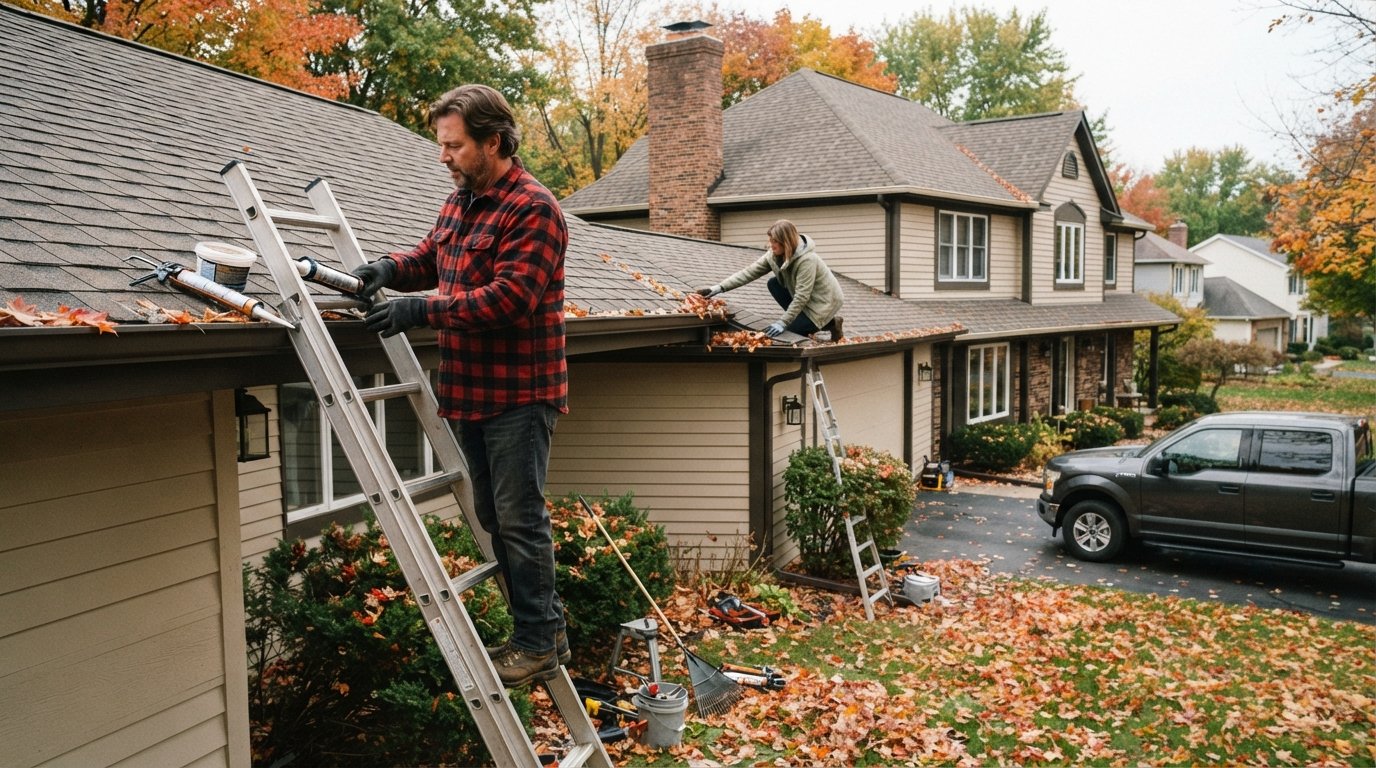
Gutters matter just as much. When they clog with leaves, water backs up under the roof edge and pools around your foundation. Clean them after the leaves drop in your area, then flush the downspouts with a hose to confirm water flows freely. While you are up there, check that downspouts discharge at least four to six feet away from the foundation and consider adding extensions if they do not.
- Inspect shingles, flashing, and seals from the ground with binoculars
- Clear gutters and flush downspouts after peak leaf fall
- Verify downspouts direct water well away from the foundation
- Look for cracked pipe boots around plumbing vents
- Schedule a professional roof inspection if the roof is over 15 years old
If climbing a ladder is not something you want to do, a local roofing contractor can handle the inspection and minor repairs in a single visit, often for the cost of a service call. That is a reasonable trade for the peace of mind that comes with knowing your roof can handle a snow load.
Seal the Envelope: Air Leaks, Insulation, and Windows
Heating accounts for the largest share of winter energy bills, and every air leak you seal in fall is money you keep all season. Walk your home's perimeter and feel for drafts around windows, doors, and where utility lines and pipes enter the walls. A burning incense stick or a hand held near a suspect gap will reveal leaks you cannot feel with your hand alone. Pay particular attention to the attic hatch, basement rim joists, and the gaps around outdoor faucets and dryer vents.
Once you have found the leaks, seal them with caulk or spray foam rated for the application. Add or replace weatherstripping on exterior doors, and install door sweeps where you can see daylight underneath. In the attic, check that insulation is evenly distributed and at least as deep as your local code recommends; adding a few inches of blown-in insulation is one of the highest-return upgrades a homeowner can make.
Windows deserve their own pass. Cracked glazing, failed seals, and rotting frames all let cold air and moisture in. If your windows are single-pane or visibly deteriorated, fall is a smart time to get quotes, since contractors are often less booked than in spring. You can read more about budget-friendly fall maintenance planning to see how to sequence these upgrades without blowing your annual home budget.
Service the Heating System Before You Need It
Nothing ruins a December evening like a furnace that will not start. Book a professional tune-up in early fall, before the first cold week when every HVAC company in town is slammed. A technician will clean the burners, check the heat exchanger for cracks, test the igniter, and verify that the system is running at the correct temperature rise. For a forced-air system, that same visit is the right time to change the filter and inspect the ductwork for disconnected runs or heavy dust buildup.
If your furnace is more than 15 years old or has needed repeated repairs, get an honest assessment of whether repair or replacement makes more sense. A failing heat exchanger is a carbon monoxide hazard, not just an efficiency problem, so never dismiss that finding. While the technician is on site, ask them to test your carbon monoxide detectors and confirm you have one on every level of the home and outside each sleeping area.
- Schedule a professional furnace or heat pump tune-up in early fall
- Replace the air filter and note the size for future changes
- Test carbon monoxide and smoke detectors, replacing batteries
- Clear vents and registers of furniture, rugs, or dust
- If you have a fireplace, have the chimney swept and inspected
Homeowners with a wood-burning fireplace or pellet stove should treat the chimney as a separate system. Creosote buildup causes thousands of chimney fires every year, and a sweep costs a fraction of the damage one spark can do. If you also run a generator or space heaters as backup, test them now and store fuel safely away from the house.
Protect the Plumbing From Freezing
Frozen pipes are the classic expensive repair that fall maintenance prevents. Before the first hard freeze, disconnect garden hoses and shut off the interior valves feeding outdoor spigots, then open the spigots to drain any remaining water. If you have a sprinkler system, blow it out with compressed air or hire a service to do it. Insulate exposed pipes in unheated crawl spaces, garages, and along exterior walls with foam sleeves or heat tape.
Know where your main water shutoff is and make sure it turns freely. If a pipe does burst while you are away, being able to kill the water quickly is the difference between a mop-up and a full flooring replacement. For homes that sit empty during winter, consider a smart water leak sensor or a shutoff valve that closes automatically when it detects flow.
Water heaters also deserve a fall check. Flush the tank to remove sediment, test the pressure relief valve, and confirm the temperature is set no higher than 120 degrees Fahrenheit to reduce scalding risk and energy waste. If your water heater is older than ten years, start budgeting for replacement now rather than waiting for it to fail on a holiday weekend.
Check the Exterior and Foundation
Walk the perimeter of your home and look at the ground. Soil should slope away from the foundation on all sides, and gutters should not be dumping water at the base of the walls. Add soil or regrade where you see ponding, and fill any cracks in the foundation or driveway with an appropriate sealant before water gets in and freezes. In cold climates, that freeze-thaw cycle is what turns a hairline crack into a structural problem.
Inspect siding, trim, and paint for peeling or gaps, because bare wood absorbs water and invites rot and insects. Caulk around exterior outlets, hose bibs, and light fixtures. Check decks and porches for loose railings, popped nails, and soft boards, and apply a fresh coat of sealer if the wood is dry and gray. Clean and store patio furniture, grills, and garden tools, and drain fuel from power equipment that will sit idle until spring.
If any of this feels beyond your comfort level, or if you simply want a professional eye on the property before winter, this is exactly the kind of work that local contractors handle every fall. You can connect with experienced local contractors who provide free estimates for inspections, repairs, and upgrades, so you can compare options and move forward with confidence rather than guessing.
Do Not Forget Safety and Storm Readiness
Fall is the right time to restock your emergency supplies and make sure your home can function through a multi-day power outage or storm. Test flashlights, charge portable batteries, and check that you have a working weather radio. Trim tree branches that overhang the roof or power lines, and remove dead limbs before ice or wind brings them down. Clean dryer vents and fireplace flues, and make sure your garage door reverses properly when it meets an obstruction.
Review your insurance coverage as well. Many policies require you to take reasonable steps to prevent damage from freezing and storms, and documenting your fall maintenance with photos and receipts can help if you ever need to file a claim. A simple folder or digital album with dated photos of your roof, gutters, and foundation gives you evidence that you did your part.
Finally, put the whole checklist on a calendar. Spreading these tasks across two or three weekends in September and October keeps the work manageable and ensures nothing gets skipped. The homeowners who avoid five-figure surprises are rarely lucky; they are simply consistent about seasonal upkeep.
Work through this fall home maintenance checklist to prevent costly repairs a little at a time, and you will head into winter with a home that is sealed, heated, and ready for whatever the season brings. When a task calls for a licensed professional, get two or three free estimates, ask for proof of insurance, and schedule the work before the first freeze. Your future self, staring at a warm house during the first snowstorm, will thank you.