
Heat Pump Water Heater Versus Tankless Cost Comparison
Compare heat pump and tankless water heater costs, from upfront install to long-term savings. Call (833)-439-3727 to explore your options.

By Leo Dawson
Learn more about Water Heater Installation or Replacement for guides, costs, and what to expect.
Compare Water Heater Installation or Replacement Pros Near You

Enter your ZIP code to compare independent local professionals and request free quotes.
Replacing a water heater is one of those home projects that sneaks up on you. One morning the shower runs cold, the unit is leaking, and suddenly you are comparing technologies you have never thought much about. The two options that dominate the conversation right now are heat pump water heaters and tankless units, and the heat pump water heater versus tankless cost comparison is rarely as simple as the sticker price on the box. Upfront equipment, installation labor, electrical work, operating costs, climate, household size, and available incentives all move the math in different directions.
This guide breaks down those moving parts so you can see which option fits your home and your budget. We will look at what each system costs to buy and install, how much it costs to run in different parts of the country, what rebates and incentives can change the equation, and how maintenance and lifespan factor into the long-term picture. By the end, you should have a clear framework for deciding whether a heat pump or tankless water heater makes more sense for your household, and how to get competitive quotes from independent local providers for either path.
How Heat Pump and Tankless Water Heaters Work
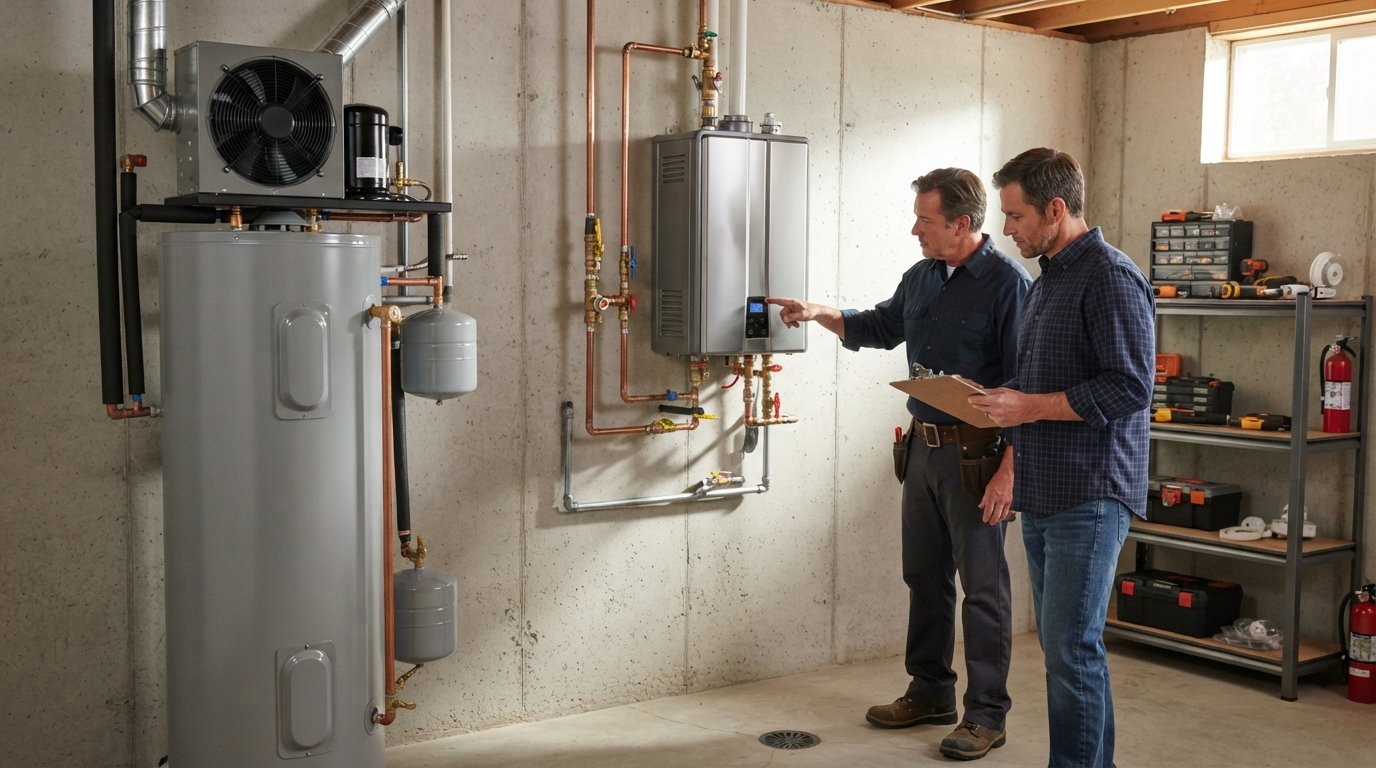
A heat pump water heater looks like a conventional tank unit, but it works very differently. Instead of generating heat directly with electric resistance elements, it moves heat from the surrounding air into the tank using a compressor and refrigerant loop. Think of it as a refrigerator running in reverse. Because it moves heat rather than creating it, a heat pump water heater can be two to three times more efficient than a standard electric tank. The tradeoff is that it needs a conditioned or semi-conditioned space with adequate air volume, and it produces cool, dry exhaust air that has to go somewhere.
A tankless water heater, by contrast, heats water on demand as it flows through a heat exchanger. There is no storage tank, so you are not paying to keep 40 or 50 gallons hot around the clock. Gas tankless units are common, and electric tankless models exist too, though they require significant electrical capacity. The appeal is endless hot water, a small wall-mounted footprint, and lower standby losses. The catch is that tankless units can struggle to keep up with simultaneous demand from multiple fixtures, and installation often requires gas line upgrades or electrical panel work.
Understanding these mechanical differences matters because they drive almost every cost difference you will encounter. A heat pump unit is a marathon runner: slower to recover but cheap to operate. A tankless unit is a sprinter: instant and compact but sensitive to demand and installation constraints. Your household habits and your home's existing infrastructure will determine which profile fits better.
Upfront Cost, Installation Requirements, and Space Needs
The first number most homeowners look at is the purchase price, but the installed cost is what actually hits your bank account. A heat pump water heater typically runs somewhere between $1,200 and $2,000 for the equipment alone, depending on tank size and features. Installation adds several hundred to over a thousand dollars, especially if you need electrical work, condensate drainage, or ducting for the exhaust air. A tankless gas unit often costs $1,000 to $1,800 for the equipment, but installation can be far more involved: venting, gas line sizing, and sometimes a new electrical circuit for the controls. Electric tankless models are cheaper to buy but frequently require a panel upgrade to handle the high amperage draw.
Space needs also differ in ways that affect cost. Heat pump water heaters need a footprint similar to a standard tank, plus clearance for airflow. They work best in garages, basements, or utility rooms with at least 700 to 1,000 cubic feet of air volume, and they need a drain for condensate. In a tight closet, you may need to add louvered doors or a duct kit, which adds cost. Tankless units are wall-mounted and save floor space, but they need clearance for venting and access for maintenance. In some homes, the venting route alone can add $500 to $1,500 to the project.
Here is a quick comparison of the main upfront factors:
- Equipment cost: Heat pump units generally cost more than gas tankless but less than premium condensing tankless models.
- Installation complexity: Heat pump units need electrical and condensate work; tankless units often need gas, venting, or panel upgrades.
- Space and clearance: Heat pump units need air volume and a drain; tankless units need wall space and vent clearance.
- Retrofit costs: Switching from a standard tank to tankless often triggers the most ancillary work, while heat pump retrofits are usually simpler.
The practical takeaway is that the heat pump water heater versus tankless cost comparison at the install stage depends heavily on what your home already has. If you have an existing electric tank in a garage with a nearby drain, a heat pump swap is often straightforward. If you are moving from a tank to a gas tankless unit and the gas line is undersized, the project can balloon quickly. Getting a written quote that itemizes equipment, labor, permits, and any required upgrades is the only way to compare fairly.
Operating Cost Estimates by Climate and Household Size
Operating cost is where the heat pump water heater versus tankless cost comparison gets interesting. Heat pump water heaters are highly efficient, often with a uniform energy factor above 3.0, which means they deliver roughly three units of heat for every unit of electricity consumed. Tankless gas units are also efficient, with energy factors around 0.8 to 0.9 for condensing models, but the price of gas versus electricity in your area drives the actual dollar difference. In regions with low electricity rates, heat pump units usually win on monthly cost. In areas with cheap natural gas and high electricity prices, a condensing tankless unit can be competitive.
Household size changes the picture too. A heat pump water heater stores hot water in a tank, so recovery time matters. A family of four with staggered shower schedules may never notice the slower recovery, while a household that runs the dishwasher, laundry, and two showers at once could run out of hot water. Tankless units handle high simultaneous demand better in gas configurations, but electric tankless models may require load management. Larger households tend to benefit more from tankless endless hot water, while smaller households often capture the full efficiency benefit of a heat pump tank without any lifestyle adjustment.
Climate adds another layer. Heat pump water heaters pull heat from the surrounding air, so they are most efficient in warm climates and in spaces that stay above 40 to 50 degrees Fahrenheit year-round. In a cold garage, efficiency drops and the unit works harder. Some models offer hybrid modes that fall back on resistance heating in cold conditions, but that erodes the savings. Tankless units are largely climate-agnostic once installed, though cold incoming water temperatures mean the unit must raise water temperature further, which can reduce flow rates in winter. Homeowners in cold climates should size tankless units carefully and consider the groundwater temperature when estimating performance.
As a general framework, compare quotes using local utility rates rather than national averages. Ask each installer for an estimated annual operating cost based on your household size, your utility rates, and the model they propose. That number, not the sticker price, is the one that compounds over the life of the equipment.
Rebates and Incentives That Change the Math
Incentives can swing the heat pump water heater versus tankless cost comparison by hundreds or even thousands of dollars. Heat pump water heaters are frequently eligible for utility rebates because they reduce peak electric demand and lower overall energy use. Some states and local utilities offer mail-in rebates, instant discounts at the point of sale, or low-interest loan programs. Federal tax credits have also historically favored heat pump technology, though program details and eligibility rules change, so verify current offerings with your utility and a tax professional before counting on them.
Tankless units are less consistently incentivized. Some gas utilities offer rebates for high-efficiency condensing tankless models, and a few regions have programs that encourage tankless conversions to free up space or reduce venting issues. However, the incentive landscape for tankless is generally thinner than for heat pump water heaters, which are viewed as a key electrification technology. That means the already lower operating cost of a heat pump unit is often paired with a lower net upfront cost after rebates, which can shorten the payback period substantially.
Do not overlook non-cash incentives either. Some utilities offer free installation of controlled devices or time-of-use rate programs that pair well with heat pump water heaters, letting you heat water when electricity is cheapest. If you are also considering solar, pairing a heat pump water heater with a rooftop system can further reduce operating costs, and resources like FreeSolarPowerQuotes can help you understand how solar quotes work for homeowners. The key is to gather actual incentive paperwork before you sign a contract, because installers do not always track every program available in your area.
Maintenance and Lifespan Differences
Lifespan and maintenance costs are the quiet factors in the heat pump water heater versus tankless cost comparison. A well-maintained heat pump water heater typically lasts 10 to 15 years, similar to a conventional tank. Tankless units often last 20 years or more, but they require regular descaling, especially in areas with hard water. Annual maintenance for a tankless unit, including flushing and filter cleaning, can run $100 to $250 per year if you hire a professional. Heat pump units need filter cleaning, condensate line checks, and occasional coil cleaning, which most homeowners can handle themselves, though professional service visits are still wise every few years.
Repair costs also differ. Heat pump water heaters have more complex components, including a compressor and refrigerant system, so major repairs can be expensive. Tankless units have fewer moving parts but can suffer from scale buildup and sensor failures. The financial takeaway is that tankless units may last longer but cost more to maintain annually, while heat pump units have lower routine maintenance but potentially higher repair costs if a major component fails. Factoring a modest annual maintenance budget into your comparison prevents surprises later.
If you want to compare installation quotes for either option, a free matching service can connect you with independent local providers who work with these technologies. You can also review tankless water heater costs and savings for homeowners to see how tankless pricing breaks down in more detail before you request bids.
Making the Decision for Your Home
The right choice comes down to your household patterns, your home's existing infrastructure, your local energy prices, and the incentives available in your area. If you have a family that runs multiple showers at once, a gas tankless unit may deliver the endless hot water you want, provided your gas line and venting can support it. If you have a smaller household, a garage or basement with adequate air volume, and access to heat pump rebates, a heat pump water heater often delivers the lowest total cost of ownership.
Run the numbers in this order: installed cost after incentives, estimated annual operating cost at your utility rates, expected maintenance over the lifespan, and replacement timeline. That sequence gives you a realistic total cost of ownership rather than a misleading sticker comparison. When you request quotes, ask each provider to itemize equipment, labor, permits, and any required electrical, gas, or venting upgrades so you can compare apples to apples. A free matching service makes it easy to gather multiple no-obligation quotes from independent local providers and choose the option that fits your budget and your home.