
How to Choose Energy Efficient Appliances by Energy Star Ratings
Learn how to choose energy efficient appliances by energy star ratings and cut monthly bills. Call (833)-439-3727 for expert guidance on upgrades.

Learn more about Appliance Repair or Maintenance for guides, costs, and what to expect.
Compare Appliance Repair or Maintenance Pros Near You

Enter your ZIP code to compare top-rated local professionals and request free quotes.
Your refrigerator runs 24 hours a day. Your washing machine runs several times a week. Over a decade, those operating costs can quietly add up to more than the purchase price itself. That is why shopping for appliances based on the sticker price alone is a losing game. The smarter approach is to decode the yellow EnergyGuide label and the blue Energy Star badge, then compare real operating costs across models. This guide walks you through how to choose energy efficient appliances by Energy Star ratings, from reading the fine print to matching efficiency upgrades to your actual household habits.
Start With the EnergyGuide Label, Not the Price Tag
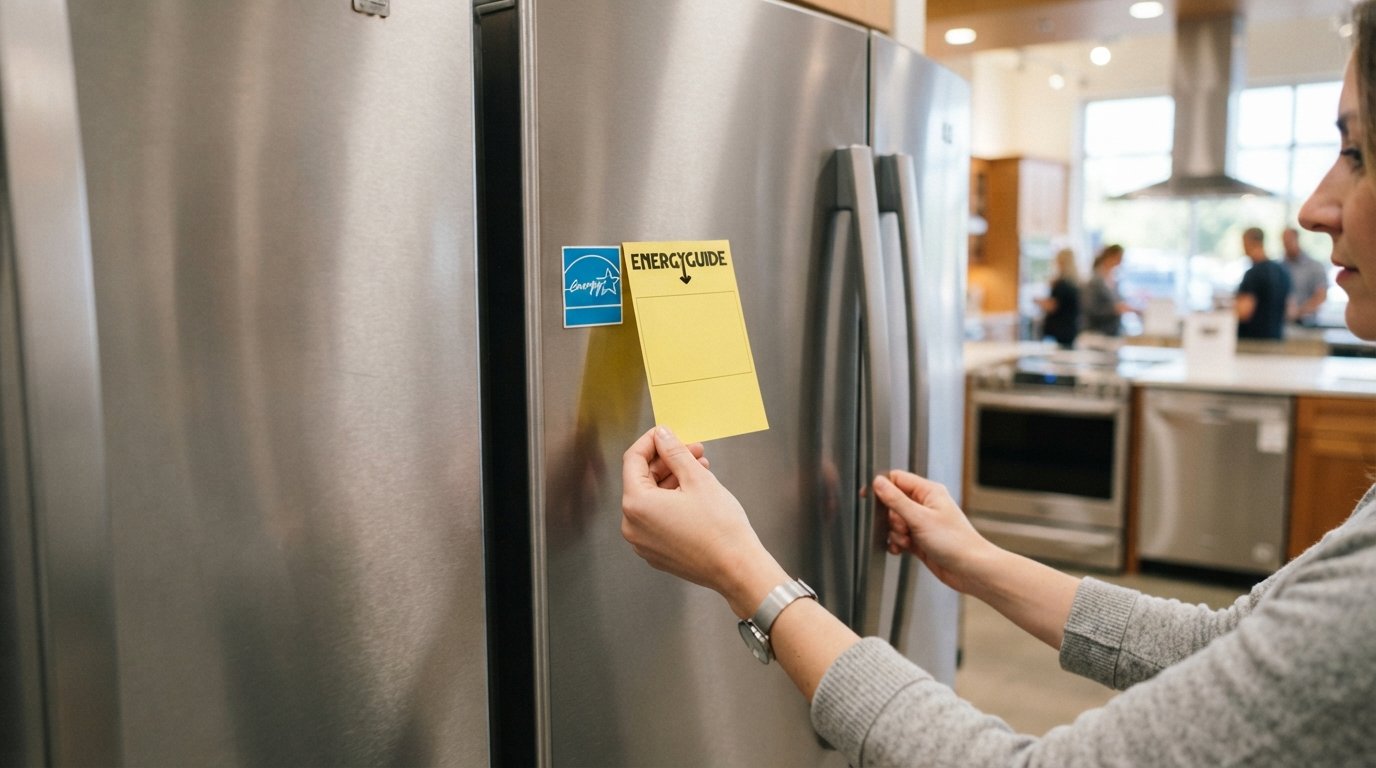
Every new appliance sold in the United States comes with a yellow EnergyGuide label. This label is your first and most reliable tool for comparing operating costs. It shows an estimated yearly energy use in kilowatt-hours (kWh) and an estimated yearly operating cost based on a national average electricity rate. The label also places the model on a scale from least efficient to most efficient among comparable units, so you can see at a glance where it stands.
To translate that yearly estimate into a monthly figure, simply divide by 12. For example, a refrigerator with a $72 yearly estimate costs about $6 per month to run. That sounds small, but compare it to an older model that might use $150 per year, and the difference is $78 annually, or $780 over ten years. Multiply that across a kitchen full of appliances, and the savings become substantial.
Keep in mind that the EnergyGuide estimate uses a national average electricity rate. If your local rate is higher, your actual costs will be higher too. Check your utility bill for your rate per kWh and adjust the estimate accordingly. This step alone can help you avoid choosing a model that looks cheap upfront but costs more over time.
Understand What the Energy Star Badge Really Means
Energy Star is a voluntary program run by the U.S. Environmental Protection Agency and the Department of Energy. When you see the blue Energy Star badge, it means the appliance meets or exceeds efficiency standards set by the program, which are typically stricter than the federal minimum. However, the badge does not tell you how much more efficient a given model is compared to others. Two Energy Star refrigerators can have very different operating costs.
That is why the EnergyGuide label remains essential even when an appliance is Energy Star certified. Think of Energy Star as a baseline filter: it quickly eliminates the least efficient models from your search. Then use the EnergyGuide label to compare the remaining candidates on actual energy use. This two-step approach saves time and ensures you are not paying a premium for a badge without checking the real numbers behind it.
It is also worth noting that Energy Star standards vary by appliance category. A refrigerator that qualifies for Energy Star may be 10 to 15 percent more efficient than the federal minimum, while a washing machine might need to be 20 percent more efficient. The program updates its criteria periodically, so a model that earned the badge five years ago may no longer meet current standards. Always check the current Energy Star product list on the program website to confirm a model is still certified.
Which Appliances Offer the Fastest Payback?
Not all efficiency upgrades deliver the same return on investment. Some appliances run constantly and consume large amounts of energy, so upgrading them yields faster savings. Others are used less frequently, so the payback period stretches out. Here is a quick ranking of common appliance categories by typical payback speed, assuming you are replacing an older, less efficient unit with a new Energy Star certified model.
- Refrigerators: Because they run 24/7, refrigerators often deliver the fastest payback. A new Energy Star model can use 40 percent less energy than a refrigerator from 15 years ago. If your old fridge is still running, replacing it is usually the highest-impact move.
- Washing machines: Energy Star clothes washers use about 25 percent less energy and 33 percent less water than standard models. If you wash multiple loads per week, the savings add up quickly, especially if you have a high electricity rate.
- Water heaters: While not always classified as an appliance, water heaters are among the biggest energy users in many homes. Upgrading to an energy-efficient model (tankless or heat pump) can cut water heating costs significantly, though the upfront price is higher.
- Dishwashers: Energy Star dishwashers use less hot water than hand washing and about 12 percent less energy than standard models. Payback is moderate, but the water savings are a bonus.
- Dryers: Clothes dryers are less regulated for efficiency, but heat pump dryers are now available and use far less energy. Payback is slower, but they are worth considering if you dry many loads.
Use this ranking as a starting point, but remember that your household usage patterns matter. A large family that runs the washer daily will see faster payback than a single person who washes once a week. The next section explains how to match efficiency upgrades to your actual habits.
Match Efficiency Upgrades to Your Household Usage Patterns
The most efficient appliance in the store is not necessarily the best choice for your home. You need to match the appliance's capacity and features to how you actually live. For example, a family of five will benefit from a larger, more efficient refrigerator and a high-capacity washer, while a single homeowner might save more with a smaller, right-sized model. Oversizing an appliance wastes energy and money.
Consider these usage questions before you buy:
- How many loads of laundry do you run per week? If it is more than five, a high-efficiency washer with a fast spin cycle will pay off faster.
- Do you use your dishwasher daily or only for special occasions? Daily use justifies a higher-efficiency model; occasional use may not.
- How old is your current refrigerator, and is it running efficiently? A fridge from the early 2000s could be costing you $100 or more per year in extra energy.
- Do you have time-of-use electricity rates? If so, running appliances during off-peak hours can amplify savings, regardless of the model's efficiency rating.
Once you understand your patterns, you can prioritize upgrades that match your biggest energy drains. A homeowner who rarely cooks might not need a high-end efficient oven, but they might benefit hugely from a new refrigerator and washer. The goal is to direct your budget toward the upgrades that will actually reduce your monthly bills.
Factor In Rebates and Tax Incentives to Offset Upfront Costs
Energy-efficient appliances often cost more upfront than standard models, but rebates and tax incentives can narrow the gap. Many utility companies offer rebates for Energy Star certified appliances, especially refrigerators, washing machines, and water heaters. These rebates can range from $25 to several hundred dollars, depending on the appliance and your location. Check your utility's website or call them directly to see what is available.
At the federal level, tax credits and incentives for energy-efficient home improvements have expanded in recent years. While not all appliances qualify, certain heat pump water heaters and other high-efficiency equipment may be eligible for tax credits. The rules change, so consult a tax professional or the IRS website for current details. State and local programs may also offer additional incentives.
To maximize savings, stack rebates with store promotions and financing offers. Some retailers offer special financing on Energy Star appliances, which can make the upfront cost more manageable. Just be sure to read the fine print on deferred interest offers, as they can backfire if you do not pay off the balance in time. When you combine rebates, tax incentives, and smart shopping, the effective price of an efficient appliance can be much closer to a standard model than you might expect.
If you are planning a larger appliance upgrade as part of a kitchen or laundry room remodel, it helps to understand the full scope of costs and savings. Our guide on energy efficient appliance upgrades: costs and savings breaks down typical expenses and payback periods so you can budget with confidence.
Read the Fine Print: Capacity, Features, and Real-World Performance
Two refrigerators with the same Energy Star rating can have very different real-world performance depending on their features. For example, a model with an ice maker and through-the-door dispenser will use more energy than a similar model without those features. The EnergyGuide label accounts for some of this, but not all. Always compare the estimated yearly kWh use, not just the badge.
Similarly, consider how you will use the appliance. A washer with a sanitize cycle or steam feature may use more energy than a basic model, even if both are Energy Star certified. If you rarely use those extras, you may be paying for efficiency you will not fully benefit from. Look for models with simple, effective cycles that match your needs.
Also pay attention to installation requirements. Some high-efficiency appliances, like heat pump water heaters, require specific space and ventilation. A tankless water heater may need upgraded gas lines or electrical work. Factor these installation costs into your total budget. If you are unsure, a qualified contractor can assess your home and recommend the right model. You can find trusted local contractors who specialize in appliance installation and energy upgrades, making the process smoother and safer.
Use the Energy Star Product Finder and Compare Models Side by Side
The Energy Star website offers a product finder tool that lets you filter by appliance type, brand, capacity, and features. This is a powerful way to narrow your search to certified models. Once you have a shortlist, compare the EnergyGuide labels side by side. Many retailers also display energy use information on their product pages, so you can quickly compare estimated yearly costs.
Create a simple comparison table for your top three models. Include purchase price, estimated yearly energy use, estimated yearly cost, rebates available, and any special features. This will give you a clear picture of the total cost of ownership over five or ten years. Often, the model with the lowest sticker price is not the cheapest over time. By comparing total cost of ownership, you make a decision that aligns with your budget and your long-term savings goals.
Finally, do not overlook the value of professional advice. An experienced appliance installer or energy auditor can help you understand which upgrades will deliver the biggest impact in your specific home. They can also alert you to any electrical or plumbing upgrades needed to support a new appliance, preventing costly surprises down the line.
Choosing energy-efficient appliances by Energy Star ratings is a straightforward process once you know where to look. Start with the EnergyGuide label, use Energy Star as a filter, prioritize appliances with the fastest payback for your household, and take advantage of rebates and incentives. With a little research, you can lower your monthly bills and enjoy the peace of mind that comes with a more efficient home.