
Smart Home Water Leak Detector Cost and Savings Guide
Smart home water leak detector cost and savings explained: hardware runs $15 to $900, and one avoided claim pays it back. Call 8334393727 for free estimates.

By Leo Dawson
Learn more about Smart Home Installation or Repair for guides, costs, and what to expect.
Compare Smart Home Installation or Repair Pros Near You

Enter your ZIP code to compare top-rated local professionals and request free quotes.
A single burst supply line can release hundreds of gallons of water into your home while you sleep, and the average insurance claim for water damage tops $11,000. That is why so many homeowners are now asking the same question: what does a smart home water leak detector actually cost, and can it really pay for itself? The short answer is yes, often within a single avoided incident. The longer answer involves upfront hardware prices, optional professional installation, insurance discounts, and the very real savings that come from shutting off a leak in seconds instead of hours.
This guide breaks down real-world pricing for every major category of leak detection technology, from $20 standalone pucks to whole-house automatic shutoff systems. You will also see how those costs translate into savings through lower premiums, reduced repair bills, and protection for the systems that matter most in a modern home. If you are already planning electrical or plumbing upgrades, it helps to think about leak detection at the same time: our guide on electrical panel upgrade costs, signs, and savings explains how to bundle infrastructure projects so you only pay for one round of contractor visits.
How Smart Water Leak Detectors Work
Every smart leak detector relies on the same basic principle: water conducts electricity. When moisture bridges two sensor contacts, the device triggers an alert. What separates a basic alarm from a smart system is what happens next. A basic unit sounds a local siren. A smart unit pushes a notification to your phone, logs the event in an app, and in advanced models, commands a motorized valve to shut off the main water supply automatically.
There are three functional tiers worth understanding before you shop. First, spot detectors sit under a sink, behind a toilet, or beside a water heater and monitor one small area. Second, whole-home sensor kits place multiple pucks around the house and connect them to a central hub, often the same hub that runs your security system. Third, flow-based systems install at the main line and watch for abnormal usage patterns, such as a toilet running at 3 a.m. or a pipe losing pressure when no fixture is open. Many households combine a flow-based shutoff valve with a handful of cheap spot sensors for full coverage.
Power and connectivity also vary. Most battery-powered sensors last one to three years on a coin cell or AA batteries. Hardwired and valve-based units need a nearby outlet or low-voltage transformer, which is one reason a professional installer is sometimes the smarter choice. Connectivity runs on Wi-Fi, Z-Wave, Zigbee, or a proprietary hub, and the protocol matters if you want everything to appear in one app.
Smart Home Water Leak Detector Cost Breakdown
Prices vary widely because the category spans simple alarms and full plumbing automation. The table below reflects typical U.S. retail pricing in 2026, before any installation labor. Treat these as planning ranges rather than fixed quotes, since sales and bundles shift constantly.
- Standalone spot sensor: $15 to $50 each. Good for a single risk zone such as a laundry closet or under-sink cabinet.
- Multi-pack sensor kit with hub: $100 to $300 for three to six sensors. The best value for most homes.
- Flow-based smart valve (retrofit): $200 to $600 for the device alone. Installs on the existing main line.
- Full system with automatic shutoff and sensors: $400 to $900 in hardware.
- Professional installation: $150 to $500 for a valve, plus $0 to $150 per sensor if you want a pro to place them.
- Optional monitoring subscription: $0 to $15 per month, depending on the brand and whether cellular backup is included.
Add those numbers together and a realistic mid-range project lands between $500 and $1,200 for a home with a smart shutoff valve and five or six sensors, installed. A minimalist approach, meaning a few battery pucks and no valve, can come in under $150. The gap between those two figures is the single biggest decision you will make, and it comes down to whether you want alerts or automatic protection.
One cost trap deserves attention: older homes often have gate valves or non-standard pipe sizes that require adapters or a partial repipe at the main. If your plumbing is original to a 1970s build, ask the installer to inspect the main shutoff before quoting. A valve that cannot be retrofitted cleanly can add $200 to $600 in labor. That is also a good moment to have a licensed plumber review the whole system, since a leak detector protects pipes but does not repair the corrosion that caused the problem.
Installation Costs: DIY vs Hiring a Pro
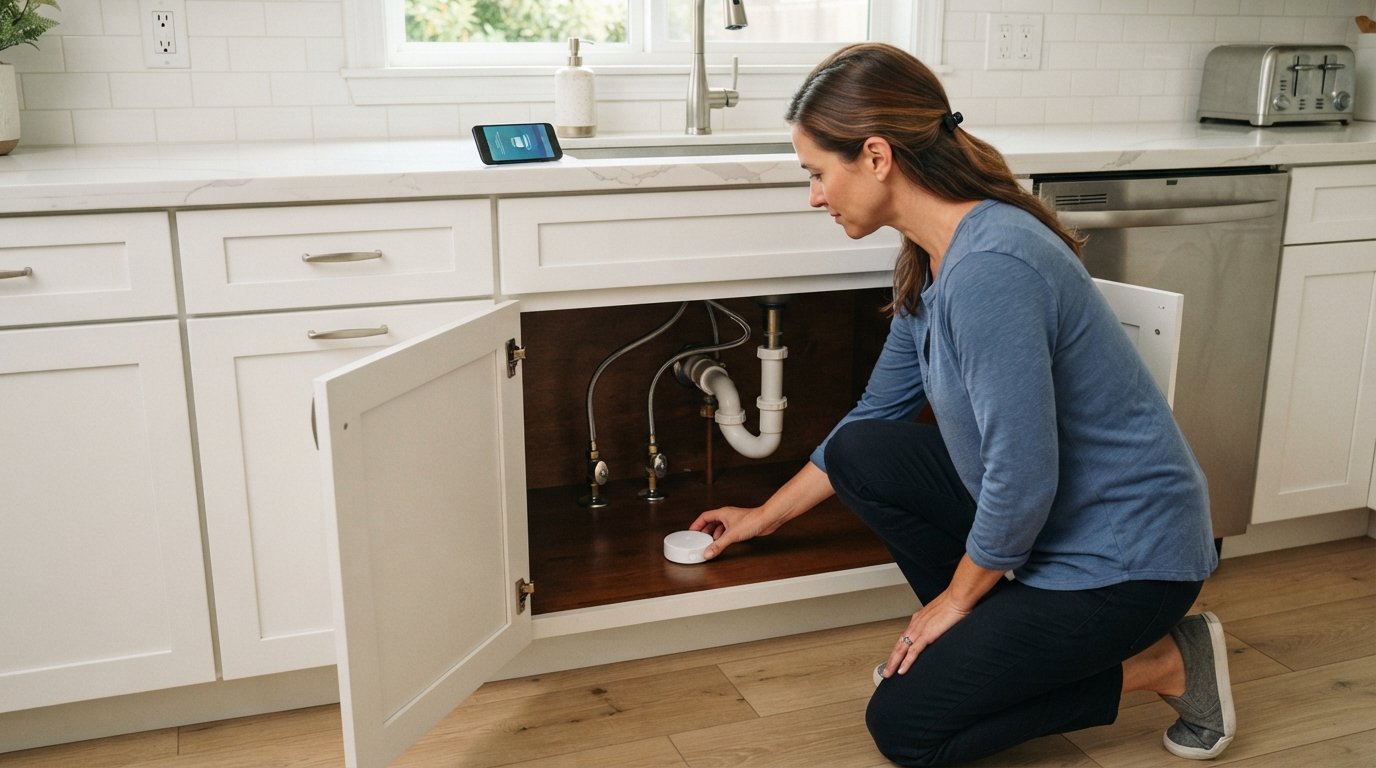
Spot sensors are genuinely DIY-friendly. They are battery powered, need no wiring, and placement takes minutes. Stick one under the kitchen sink, one behind each toilet, one beside the water heater, one near the washing machine, and one in the basement near the sump. Pairing them to an app is a five-minute task per device. If that is all you want, you can complete the project on a Saturday afternoon for the price of the kit.
Automatic shutoff valves are a different story. They require cutting into the main water line, which means shutting off water to the house, draining lines, and soldering or fitting a new valve body. Mistakes here cause exactly the kind of flooding the device is meant to prevent. Most manufacturers also require professional installation to keep the warranty valid. Budget $150 to $500 in labor for a straightforward install, more if the main line needs modification or a permit. In many jurisdictions, a plumbing permit is required, and your contractor will handle that paperwork.
This is where a free estimate pays off. Rather than guessing at labor, get two or three quotes that itemize the valve, the sensors, the permit, and any pipe modifications. If you are hiring out, our sister resource BuySellRemodel helps homeowners plan affordable improvement projects and connect with experienced local contractors, from free estimates through finished work. Comparing bids side by side is the fastest way to spot an inflated labor line or a missing permit fee.
Savings That Offset the Cost
The financial case for leak detection rests on three buckets of savings: avoided damage, insurance discounts, and reduced water waste. Avoided damage is the largest and the hardest to predict, which is exactly why it is worth quantifying. According to industry claims data, the average water damage claim runs well above $10,000 once drywall, flooring, cabinetry, and mold remediation are included. A $600 system that prevents even one such event delivers a return of roughly 1,500 percent. Even a modest $2,500 repair, such as a ruined bathroom floor from a failed supply line, pays back the hardware several times over.
Insurance discounts are the second bucket and the easiest to verify. Many major carriers now offer 5 to 15 percent off homeowner premiums for professionally installed automatic shutoff systems, and some offer smaller credits for sensor-only setups. On a $1,800 annual premium, a 10 percent discount is $180 per year, which covers a mid-range system in about four years even if it never detects a single leak. Call your agent before you buy and ask two questions: does the discount require a specific device or professional installation, and does it require an annual proof of operation? Getting those answers first prevents buying hardware that does not qualify.
The third bucket is water waste. A silently running toilet can waste 200 gallons a day; a slow slab leak can waste far more. Flow-based systems flag this within hours, and at average municipal rates that invisible loss can add $20 to $60 per month. Over a year, catching one chronic leak can offset a meaningful share of the system cost. None of these savings require a catastrophe, which is the quiet advantage of monitoring: most of the money comes back in small, boring increments plus one avoided disaster.
Matching Coverage to Your Home's Risk Zones
Not every home needs the same setup. A one-story condo with no basement and a single bathroom has far fewer failure points than a two-story house with a finished basement, a laundry room, and an irrigation line. The goal is to cover the places where water is most likely to escape and where damage would be most expensive.
Start by listing every water source and every place water travels. Then rank them by damage potential. A slow drip under a guest bathroom sink is annoying; a burst line on the second floor above a finished ceiling is a five-figure event. Sensors are cheap enough that covering both makes sense, but the shutoff valve is what protects the high-consequence zones when nobody is home.
For households that travel or leave for long stretches, the automatic valve moves from nice-to-have to essential. A sensor alert that reaches your phone while you are three states away is useful, but it still requires someone to enter the house and close a valve. An automatic shutoff does that in seconds. That single capability is the dividing line between monitoring and protection, and it is the upgrade most homeowners eventually wish they had bought first.
Choosing a System and Getting It Installed
With costs and savings mapped out, the selection process becomes straightforward. Work through it in this order:
- List your risk zones and decide whether you want alerts only or automatic shutoff.
- Check with your insurer about which devices qualify for a discount, and get that in writing.
- Confirm your smart home ecosystem and pick devices that integrate with it.
- Gather two or three free estimates that itemize hardware, labor, permits, and pipe modifications.
- Verify the installer is licensed and insured, and confirm the warranty terms for professional installation.
When comparing bids, look past the bottom line. A quote that is $200 cheaper but omits the permit or uses an unlisted valve may cost more in the long run. Ask each contractor how they handle the main shutoff if it is old or seized, whether they test the system after install, and what the app setup includes. A good installer will walk you through the dashboard, set your notification preferences, and show you how to test each sensor manually.
Finally, remember that leak detection is one part of a broader home protection plan. Pairing it with an annual plumbing inspection, a water heater flush, and smart electrical upgrades gives you layered protection at a fraction of the cost of a single major repair. If you are planning multiple upgrades this year, bundle them into one round of contractor visits to save on mobilization fees and scheduling headaches. The homeowners who come out ahead are the ones who plan the whole system at once rather than reacting one emergency at a time.
Smart water leak detection is one of the rare home upgrades where the math works even in the worst case, because the worst case is the one you are insuring against. Spend a few hundred dollars now, compare a handful of free estimates, and let a shutoff valve do the worrying while you sleep.