
Is DIY Cabinet Painting Worth It Versus Professional Refinishing?
Weigh DIY cabinet painting versus professional refinishing on cost, skill, and durability, then call 8334393727 for free local estimates.

By Cameron Howard
Learn more about Cabinet Refinishing and Repair for guides, costs, and what to expect.
Compare Cabinet Refinishing and Repair Pros Near You

Enter your ZIP code to compare top-rated local professionals and request free quotes.
Your kitchen cabinets take up a huge share of your remodeling budget, so it makes sense that you might look for ways to cut costs. Painting them yourself sounds like the obvious answer: a few cans of paint, a weekend of work, and you save thousands of dollars. But is DIY cabinet painting worth it versus professional refinishing in the real world? The honest answer depends on your cabinets, your skills, your schedule, and what you expect the finish to look like five years from now.
Cabinet refinishing is one of the most popular upgrades for cost-conscious homeowners because it transforms the look of a kitchen for a fraction of the price of a full replacement. The catch is that cabinets are high-touch, high-moisture surfaces, and a finish that looks great on day one can chip, peel, or gum up within a year if the prep or product choice is wrong. This guide breaks down the true costs, the skill requirements, and the scenarios where DIY pays off, plus when hiring a pro is the smarter financial move.
What DIY Cabinet Painting Actually Involves
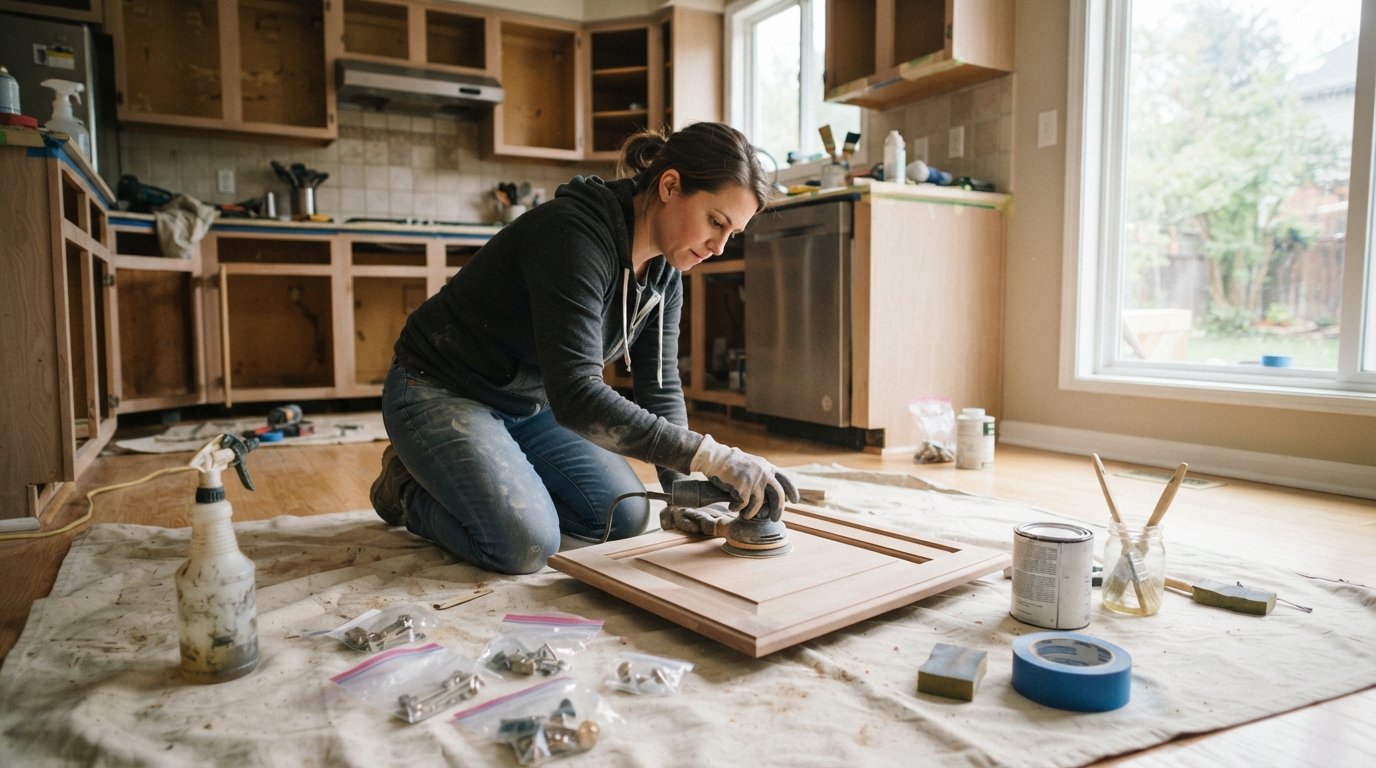
Painting cabinets is not the same as painting a wall. Walls forgive sloppy prep. Cabinet doors and drawer fronts do not. A proper DIY job means removing every door and drawer, labeling the hardware, degreasing years of kitchen grease, sanding or de-glossing the surface, filling dents, priming with a bonding primer, and then applying two or three thin coats of a cabinet-grade paint. In between coats, you sand lightly and wait for full cure times, which can stretch the project across a week or more.
You also need a dust-free space to lay doors flat while they dry. Most homeowners end up converting a garage or basement into a temporary spray booth. If you plan to spray instead of brush and roll, you need a paint sprayer with the right tip size, a respirator, plastic sheeting, and good ventilation. Brushing and rolling is cheaper but leaves visible texture unless you use a fine foam roller and a high-quality brush, and even then the finish rarely matches a sprayed factory look.
Before diving in, be honest about a few practical questions:
- Do you have 20 to 40 hours of free time over one to two weeks?
- Can you live without full access to your kitchen for several days?
- Are you comfortable sanding, caulking, and handling minor repairs?
- Do you have space to lay out dozens of doors flat while they cure?
- Will you accept a finish that is good but not factory-perfect?
If you answered yes to most of these, a DIY paint job is genuinely viable. If even two or three answers were no, the project will likely stall halfway through, which is the worst outcome because half-painted cabinets look worse than worn ones.
The Real Cost of DIY Cabinet Painting
DIY cabinet painting is affordable on paper, but the numbers add up faster than most homeowners expect. A typical kitchen has 20 to 40 cabinet doors and drawer fronts, plus the frames. You need roughly one gallon of primer and one to two gallons of cabinet-grade paint for an average kitchen, plus sandpaper, degreaser, painter's tape, caulk, brushes, rollers, and possibly a sprayer. If you already own a sprayer, your material cost may land between $150 and $300. If you need to buy one, add $150 to $400 for a decent entry-level unit.
Then there is the hidden cost of time. At 30 hours of work, a DIY job that saves $3,000 compared to professional refinishing works out to about $100 per hour of your labor, which sounds great. But that math assumes the finish holds up. If the paint peels within 18 months because the cabinets were not properly deglossed or the wrong primer was used, you will pay again, either to fix it yourself or to hire someone to strip and redo the work. Suddenly the savings shrink or disappear.
Homeowners often ask how cabinet refinishing costs compare to other upgrades. As a general rule, professional cabinet refinishing runs roughly 30 to 50 percent of the cost of new cabinets, and DIY painting runs 10 to 20 percent of that figure. The lower the upfront cost, the more the risk shifts onto your shoulders in the form of labor and durability. For a broader sense of how DIY versus professional decisions play out on other surfaces, our guide on DIY versus professional drywall repair walks through the same trade-offs of cost, skill, and finish quality.
What Professional Cabinet Refinishing Delivers
Professional refinishing is not simply someone else holding a paintbrush. Most pros use a multi-step process that includes chemical deglossing or sanding, high-build primer, and a sprayed topcoat of a two-part or waterborne catalyzed product designed specifically for cabinets. The result is a harder, more uniform finish that resists chipping, moisture, and daily wear far better than typical big-box paint applied with a roller.
Professionals also handle the parts of the job homeowners dread: removing and reinstalling doors, repairing damaged frames, filling grain, caulking seams, and coordinating the timeline so your kitchen is not out of commission for weeks. Many offer a warranty on the finish, which shifts the risk of premature failure back to the contractor. That warranty is a real value, because if the finish fails in year two, the pro fixes it at their cost, not yours.
Professional pricing varies widely by region, cabinet count, and finish type, but most homeowners pay between $2,500 and $6,000 for a full kitchen refinishing job. That is still a fraction of the $15,000 to $30,000 a full cabinet replacement can cost, which is why refinishing remains one of the highest-return cosmetic upgrades in a kitchen. If you are weighing other budget-friendly upgrades, comparing quotes for cabinets and countertops side by side often reveals where your money goes furthest.
When DIY Cabinet Painting Is Actually Worth It
DIY cabinet painting makes sense in specific situations. If your cabinets are in good structural condition, you are comfortable with basic prep work, you have the time and space, and you are willing to accept a finish that looks good from three feet away rather than showroom-perfect, DIY can save you thousands. It is also a smart option for rental properties, garages, laundry rooms, and other spaces where a flawless finish matters less than a fresh look.
DIY is also a reasonable choice if you plan to sell within a year or two and simply want to brighten a dated kitchen. A clean, neutral paint job on tired oak cabinets can help a home show better without a major investment. Just be realistic: buyers and inspectors notice drips, uneven sheen, and paint bleeding onto hinges and glass, so quality still matters.
Where DIY usually fails is on cabinets with heavy grain, glossy factory finishes, or water damage. Oak and other open-grain woods are notoriously difficult to paint smoothly because the grain telegraphs through the paint. Glossy thermofoil or laminate doors resist paint adhesion unless they are chemically deglossed, and many homeowners skip that step. Water-damaged frames will keep failing no matter how good the paint is. In those cases, the money you save on labor is money you will spend later on repairs.
When Professional Refinishing Is the Better Investment
Hiring a pro is usually the better call when the finish quality truly matters, when the cabinets are complex (glass inserts, beadboard, custom profiles), or when your schedule cannot absorb a week of kitchen disruption. It is also the right move if you tried a DIY paint job before and were unhappy with the result, or if your cabinets are the centerpiece of a kitchen you plan to enjoy for a decade or more.
Another factor is resale. In a competitive market, a professionally refinished kitchen signals quality to buyers and appraisers. A slightly lumpy DIY finish can actually raise questions about what else in the home was done on the cheap. If your goal is to maximize home value, the extra cost of professional refinishing often pays for itself at sale time.
There is also a safety and logistics angle. Spraying catalyzed finishes requires respirators, ventilation, and careful handling of solvents. Pros have the equipment and experience to do it safely. If you are not comfortable working with those materials, DIY is not just harder, it is riskier.
How to Compare DIY and Professional Quotes Fairly
The fairest comparison is not DIY paint cost versus a professional quote. It is total cost of ownership over five years. Add up your materials, your time (valued at whatever your free hour is worth to you), the risk of a failed finish, and the likelihood you will redo the job. Then compare that to a professional quote that includes prep, materials, labor, and a warranty.
When you request quotes, ask specific questions so you can compare apples to apples:
- What prep steps are included (degreasing, sanding, deglossing, priming)?
- What product line will be sprayed or rolled, and what is its expected lifespan?
- Are doors and drawer fronts removed and sprayed off-site or on-site?
- How long will the kitchen be unusable, and what is the payment schedule?
- What does the warranty cover, and for how long?
A quote that skips prep or uses wall paint instead of cabinet-grade product is not really cheaper, it is just a shorter job that will fail sooner. If you want help finding vetted local pros who can give you free estimates and compare options side by side, BuySellRemodel connects homeowners with experienced contractors for remodeling, repairs, and upgrades so you can move forward with confidence. Getting two or three quotes is the single best way to know whether DIY savings are real in your market.
Practical Steps If You Decide to Go DIY
If you have weighed the trade-offs and still want to paint your cabinets yourself, treat the project like a professional job. Start by emptying the cabinets and removing all doors, drawers, hinges, and hardware. Label everything with painter's tape and a marker so you can reassemble without guesswork. Degrease every surface with a kitchen-safe cleaner, then rinse and let it dry completely.
Next, degloss the surface. For most factory-finished cabinets, a liquid deglosser is faster and less messy than sanding, but sanding with 220-grit gives a more reliable mechanical bond. Follow with a bonding primer designed for glossy surfaces. Then apply thin coats of a cabinet-grade paint, sanding lightly between coats. Resist the urge to lay it on thick to save time; thin coats cure harder and look smoother.
Let the final coat cure for at least a week before hanging doors and using the cabinets normally. Cure time is not the same as dry time, and most DIY paint failures happen because homeowners reinstall doors too soon. Once cured, add bumpers to the backs of doors and touch up around hinges and pulls as needed.
The Bottom Line on DIY Versus Professional Cabinet Refinishing
Is DIY cabinet painting worth it versus professional refinishing? For patient homeowners with simple cabinets, good prep skills, and realistic expectations, DIY can save thousands and deliver a solid result. For anyone short on time, working with complex or glossy cabinets, or expecting a factory-quality finish that lasts a decade, professional refinishing is the better investment. The gap between the two is not just money, it is durability, warranty coverage, and how the kitchen looks and feels every day.
Before you commit either way, get at least one professional estimate. It costs nothing, gives you a real number to compare against your DIY plan, and often reveals options you had not considered. Whether you paint it yourself or hire a pro, the goal is the same: a kitchen you are happy to walk into every morning, without paying for it twice.