
Whole House Fan vs Attic Fan: Cost and Cooling Savings
Compare whole house fan versus attic fan cost and cooling savings, then call (833)-439-3727 to plan a budget-friendly cooling upgrade.

By Ethan Owens
Learn more about Fan Installation for guides, costs, and what to expect.
Compare Fan Installation Pros Near You

Enter your ZIP code to compare top-rated local professionals and request free quotes.
When summer heat settles in and your air conditioner starts running nonstop, the electric bill becomes a source of real anxiety. Two of the most talked-about alternatives are whole house fans and attic fans, and homeowners often assume the two terms describe the same product. They do not. Choosing between them affects what you pay upfront, how much you save each month, and how comfortable your home actually feels. A whole house fan versus attic fan cost and cooling savings comparison comes down to understanding what each machine does, where it works best, and how your local climate shapes the math. This guide breaks down installation costs, electrical requirements, ducting differences, energy savings versus central air, and the maintenance and noise tradeoffs so you can decide which option fits your home and your budget.
How Whole House Fans and Attic Fans Work
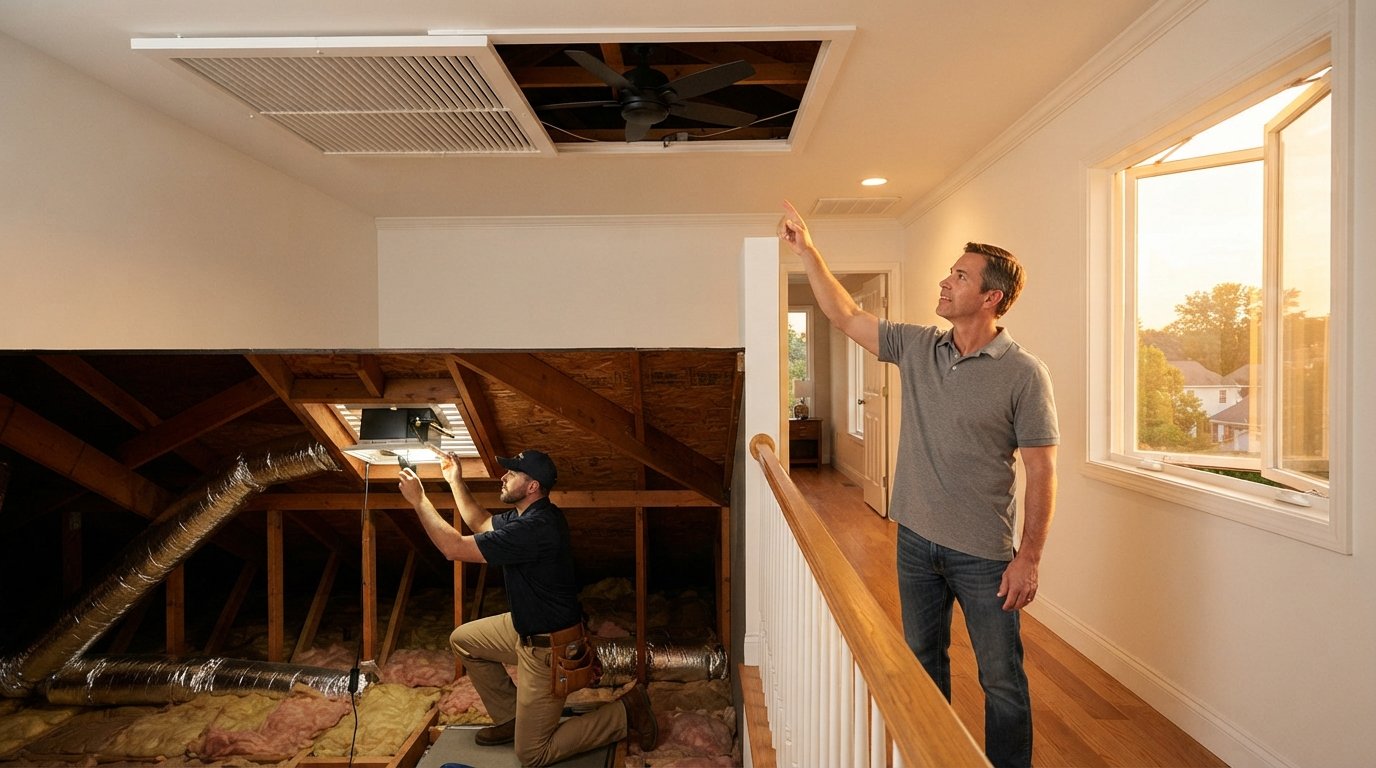
A whole house fan is a large, high-volume fan mounted in the ceiling, usually in a central hallway or upstairs landing, that pulls air through open windows and pushes hot indoor air out through attic vents. The operating principle is simple: when outdoor air is cooler than indoor air, typically in the evening or early morning, the fan exchanges the entire volume of your home's air in a matter of minutes. That fresh, cooler air flushes out the heat that has built up in walls, furniture, and drywall during the day. Many whole house fans are two-speed units, and modern models can move thousands of cubic feet per minute, enough to cool a typical house quickly.
An attic fan, by contrast, does not cool your living space directly. It is mounted in the gable or roof of the attic and exhausts superheated attic air to the outside, pulling cooler outside air in through soffit vents. By lowering attic temperatures, it reduces the heat that radiates down through the ceiling into your rooms. This makes the air conditioner's job easier and extends the life of your roof shingles, but it does not replace the AC on its own. Attic fans are usually smaller, simpler, and less expensive than whole house fans, and some models run on solar power.
The climate where each performs best matters enormously. Whole house fans shine in dry, temperate climates with cool evenings, such as the Southwest, mountain states, and coastal California. In humid regions like the Southeast, pulling in moist evening air can make the house feel clammy, so homeowners there often run the fan only during dry stretches. Attic fans are useful almost anywhere attics overheat, but they deliver the most benefit in hot, sunny climates with poorly ventilated attics. Neither fan replaces air conditioning entirely in extreme heat; they reduce how often the AC must run.
Installation Cost, Electrical Needs, and Ducting Differences
Cost is where the two options diverge sharply. A whole house fan requires cutting a large opening in the ceiling, often reinforcing framing, running dedicated electrical wiring, and installing a louvered grille and possibly a timer or humidistat. Because the fan sits inside the conditioned envelope and pushes air into the attic, the attic must have adequate venting, typically one square foot of net free vent area per 750 cubic feet per minute of fan capacity, or the fan will pressurize the attic and fail to move air. Many homes need additional gable or ridge vents, which adds cost. Professional installation for a whole house fan generally runs from about $1,000 to $3,500 depending on home size, fan quality, and whether venting or electrical upgrades are needed.
Attic fans are simpler. A gable-mounted fan installs into an existing vent opening or a new cutout in the gable end, wired to a thermostat or switch. Roof-mounted solar attic fans need no household wiring at all, which keeps installation costs low. Typical installed costs range from roughly $300 to $1,200, with solar models often landing in the middle of that range. If your attic lacks soffit vents, though, an attic fan cannot pull air effectively and you may need vent work first.
Electrical needs follow the same pattern. A whole house fan draws anywhere from 200 to 700 watts depending on size and speed, and it needs a dedicated circuit, which may mean a panel upgrade in older homes. If your electrical system is already strained, it is worth reviewing what a service upgrade involves before adding a large motor; our guide on whole house rewire cost and signs you need one explains when older wiring should be addressed first. Attic fans draw far less, often 50 to 150 watts for gable units and effectively zero for solar models, and many can tie into existing attic lighting circuits. Ducting is not required for either fan, which is a key advantage over central air, but whole house fans do require a properly vented attic and open windows throughout the house to work safely.
Estimated Energy Savings Versus Running Central Air
The savings story is the heart of the whole house fan versus attic fan cost and cooling savings question. Central air conditioning typically consumes 3,000 to 5,000 watts per hour when running, and in a hot climate it may run six to ten hours a day. A whole house fan running for two to four hours in the evening might use 0.5 to 2 kilowatt-hours, costing pennies in most markets. Homeowners who substitute fan cooling for AC during mild evenings often report cooling-related electricity savings of 30 to 50 percent in shoulder seasons, and some utilities estimate a whole house fan can cut summer cooling costs by 50 to 90 percent compared with air conditioning alone, depending on climate and habits.
Attic fan savings are smaller but still real. By dropping attic temperatures by 20 to 40 degrees Fahrenheit, an attic fan reduces the heat gain through your ceiling, which can trim AC runtime by 10 to 30 percent in homes with overheated attics. The fan itself consumes little power, so the net effect on the bill is usually modest but positive. The catch is that an attic fan does nothing for comfort when the AC is off; it only makes the AC more efficient.
To put numbers in perspective, consider a homeowner paying $180 a month for summer cooling. A well-sized whole house fan used strategically might cut that to $90 to $120, saving $60 to $90 monthly during the cooling season, which can recoup a $2,000 installation in three to four summers. An attic fan costing $700 might save $15 to $40 a month, paying back in two to four years. Neither beats a full HVAC replacement in a hot, humid climate, but both are low-cost efficiency upgrades worth discussing with a pro. For larger efficiency projects, browsing affordable home improvement planning resources can help you compare options and budget realistically before committing.
Maintenance and Noise Considerations
Whole house fans need periodic attention. The belt on belt-driven models should be checked annually, blades and grilles cleaned, and the motor lubricated if serviceable. Because the fan sits in the ceiling, a loose or unbalanced unit can rattle the whole hallway, and cheap single-speed models are noticeably loud. Better units use quiet, direct-drive motors and insulated doors that seal when off, preventing winter heat loss. Expect to pay $1,200 to $2,500 for a quiet, well-insulated model installed, and plan on occasional belt or motor service over a 15- to 20-year lifespan.
Attic fans are nearly maintenance-free by comparison. Gable units may need an occasional blade cleaning and thermostat check, while solar roof fans have no household wiring and few moving parts to fail. Noise is rarely an issue because the fan is separated from living space by the ceiling and attic, though a failing bearing can transmit vibration through the roof. Lifespans run 10 to 15 years for budget units and longer for quality solar models.
Safety deserves a mention for both. A whole house fan requires open windows while running; running it with the house sealed can backdraft gas appliances or pull attic air into living space. Attic fans must not depressurize the attic so much that conditioned air is drawn through ceiling leaks. A qualified electrician or HVAC technician should size and install either unit, and if your project grows into a broader efficiency upgrade, it helps to request a free estimate from a local contractor who can evaluate your attic, wiring, and venting in one visit.
Making the Choice for Your Home
Use this simple decision framework. Choose a whole house fan if you live in a dry climate with cool evenings, want to cut AC use substantially, and have or can add adequate attic venting. Choose an attic fan if your main problem is an overheated attic, your budget is tight, or you want a low-maintenance efficiency boost that supports your existing AC. Many homeowners in hot climates install both: an attic fan to tame the attic heat and a whole house fan for evening air exchange.
Whichever route you take, get at least three quotes, confirm the contractor handles any needed electrical or venting work, and ask for the fan's cfm rating and sound level in sones. A properly sized, professionally installed fan delivers the savings the marketing promises; a poorly sized one wastes money and disappoints. With clear numbers in hand, the whole house fan versus attic fan cost and cooling savings decision becomes a straightforward budget calculation rather than a guess.