
Ductless Mini Split vs Central Air: Best for Older Homes?
Compare ductless mini split vs central air for older homes. Get clear cost and disruption insights, then call (833)-439-3727 for free local HVAC quotes.

By Quinn Keller
Learn more about Central Air Conditioning Installation or Replacement for guides, costs, and what to expect.
Compare Central Air Conditioning Installation or Replacement Pros Near You

Enter your ZIP code to compare top-rated local professionals and request free quotes.
If you live in an older home, you have probably asked yourself the same question thousands of homeowners face: ductless mini split versus central air for older homes, which one actually makes sense? The answer is not as simple as picking the cheaper option or the one your neighbor installed. Older homes come with unique challenges, from solid plaster walls to historic trim that you cannot bear to tear out, and the right HVAC choice depends on your budget, your comfort goals, and how much disruption you can tolerate.
This guide breaks down the real differences between ductless mini splits and central air systems when retrofitting an older house. You will see how installation costs and disruption compare, how efficiency and zoning play out in daily use, and what maintenance and lifespan you should expect. By the end, you will have a clear framework for deciding which system fits your home and how to get comparable local estimates without getting taken for a ride.
Installation Cost and Disruption in Homes Without Ductwork
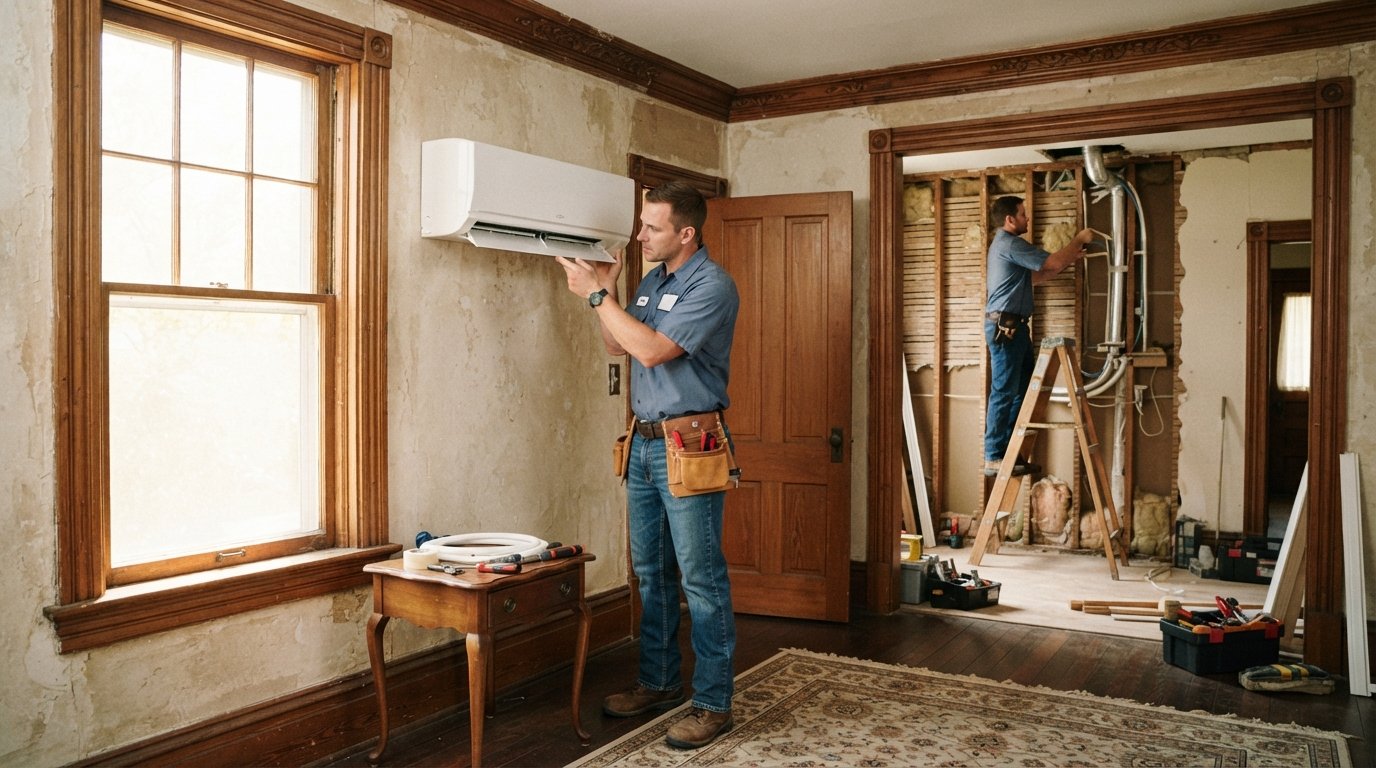
The biggest factor that separates ductless mini splits from central air in older homes is the ductwork itself. Central air requires a network of supply and return ducts running through walls, ceilings, or attics. In a newer home, those ducts are already there. In an older home, they usually are not, and adding them means cutting into finished surfaces, rearranging framing, and potentially disturbing asbestos or lead paint if the house predates 1980. That is a big deal for homeowners who want to preserve original plaster, crown molding, or hardwood floors.
Ductless mini splits avoid that entire problem. They use a small outdoor condenser connected to one or more indoor air handlers through a narrow conduit that carries refrigerant lines, power, and condensate. The conduit needs only a three-inch hole through an exterior wall, which can often be placed discreetly behind a shrub or above a foundation line. For a single-zone system, the installation can typically be completed in a day, and for multi-zone setups, two to three days is common. Central air retrofits in older homes often stretch over a week or more, especially when duct runs must be routed through closets, soffits, or attic spaces that were never designed for them.
Cost-wise, the gap is substantial. A single-zone ductless mini split for a bedroom or living area might run $3,000 to $5,000 installed, depending on the brand and local labor rates. A multi-zone system serving three to four rooms can land between $8,000 and $15,000. Central air with new ductwork in an older home often starts around $10,000 and can climb past $20,000 when duct runs are complex or when asbestos abatement or structural modifications are needed. If you are weighing other repair decisions during a renovation, our guide on DIY versus professional drywall repair can help you judge when patching walls yourself makes sense versus hiring a pro.
Disruption is not just about cost. Central air installation can generate significant dust, noise, and downtime, and you may need to vacate certain rooms for days. Ductless installation is far less invasive, though you still need a licensed HVAC technician to handle refrigerant lines and electrical connections. For older homes where preserving character matters, ductless often wins on both cost and disruption.
Efficiency, Zoning, and Comfort Tradeoffs
Modern ductless mini splits are remarkably efficient. Most units on the market today carry SEER2 ratings in the 18 to 25 range, and some premium models exceed 30. Central air systems have improved too, but even high-efficiency central units typically top out around 20 SEER2, and real-world performance drops when ducts leak or run through unconditioned attics. In older homes, duct leakage can waste 20 to 30 percent of conditioned air before it ever reaches your rooms, which erodes the efficiency advantage of central systems.
Zoning is where ductless shines. Each indoor air handler has its own thermostat, so you can cool a bedroom while leaving an unused guest room off. That room-by-room control is ideal for older homes with uneven occupancy patterns, such as a two-story house where the upstairs sits empty during the day. Central air usually cools the whole house at once unless you invest in motorized dampers and multiple thermostats, which adds cost and complexity. For older homes with additions or awkward layouts, zoning with ductless can solve hot and cold spots that plague central systems.
Comfort is a mixed bag. Ductless units deliver air directly into the room, which some people find drafty if the air handler is poorly placed. Central air distributes air more gently through registers, but that assumes the ducts are well designed and balanced. In older homes, central systems often struggle with poor static pressure and leaky ducts, leading to weak airflow in far rooms. Ductless units also dehumidify well, which matters in humid climates, but they can be slightly noisier indoors than a central system with a remote air handler. Outdoor condenser noise is comparable between the two.
One more consideration: ductless systems are heat pumps, meaning they can provide both cooling and heating. That is a major advantage in older homes that rely on baseboard heaters or radiators for winter warmth, since you can offset heating costs with the heat pump. Central air is cooling-only unless you pair it with a furnace or install a dual-fuel system, which adds expense.
Room-by-Room Versus Whole-Home Cooling Needs
How you live in your older home should drive the decision. If you spend most of your time in a few rooms, such as the kitchen, living room, and primary bedroom, a multi-zone ductless system lets you condition only those spaces. That approach saves energy and money, and it avoids the expense of running ducts to rooms you rarely use. Many older homes have small bedrooms and formal dining rooms that sit empty most of the week, so whole-home cooling is overkill.
On the other hand, if you need consistent temperatures throughout the house, especially for family members with different comfort preferences, central air with a well-designed duct system can be more convenient. You set one thermostat and forget it. But achieving that consistency in an older home often requires duct sealing, insulation upgrades, and careful balancing, which adds to the project scope. Ductless systems give you flexibility: you can start with one zone and add more later as budget allows, which is a practical path for cost-conscious homeowners.
Consider your floor plan, too. Open-concept living areas work well with a single ductless head, while closed-off rooms may need individual units. Central air can handle both, but only if the duct design accounts for door closures and room-by-room airflow. In homes with historic layouts and narrow hallways, ductless often proves more adaptable.
If you are planning a larger renovation alongside HVAC work, it helps to understand how different trades interact. For example, if your project includes wall repairs or new finishes, check our guide on affordable home improvement planning to see how to sequence contractors and keep costs in check.
Maintenance and Lifespan Expectations
Both systems require regular maintenance, but the tasks differ. Ductless mini splits need filter cleaning every month or two during heavy use, plus an annual professional tune-up that includes coil cleaning and refrigerant checks. Because the indoor units are visible, you will notice dust buildup quickly. Central air requires filter changes every one to three months, and the ducts themselves should be inspected and cleaned periodically, especially in older homes where dust and debris accumulate. Duct sealing and insulation upgrades are often necessary to keep central systems efficient.
Lifespan is comparable. A well-maintained ductless system typically lasts 15 to 20 years, and central air equipment lasts about the same. However, central air's overall system life depends on the ducts, which can degrade over decades. Older ductwork may need replacement or major sealing, adding cost that ductless avoids. Ductless systems have more individual components (each indoor head), so there are more filters to clean and more potential points of failure, but the failure of one zone does not shut down the whole house.
Repair costs vary. Ductless repairs often involve accessing the indoor unit, which is straightforward, but parts can be proprietary and sometimes pricey. Central air repairs may require attic or crawlspace access, which can be labor-intensive in older homes with tight spaces. Overall, both systems are reliable if installed correctly and maintained regularly.
How to Get Comparable Local HVAC Estimates
Getting apples-to-apples quotes is essential. Start by defining your goals: which rooms need cooling, whether you want heating as well, and what your budget ceiling is. Then invite at least three licensed HVAC contractors to assess your home. Ask each one to provide a written quote that separates equipment, labor, and any ductwork or electrical upgrades. For ductless, specify the number of zones and the model numbers. For central air, require a Manual J load calculation and a duct design plan, not just a rule-of-thumb sizing.
Use a simple comparison framework to evaluate bids:
- Equipment efficiency ratings (SEER2, HSPF2 for heat pumps) and brand reputation
- Total installed cost, including permits, electrical work, and any remediation
- Warranty terms for parts and labor, and whether maintenance is included
- Timeline and disruption plan, especially for ductwork installation
- References from similar older homes in your area
Do not be afraid to ask questions. A good contractor will explain why they recommend a particular system and how it addresses your home's specific challenges. Be wary of any bid that seems dramatically lower than the others; it may omit crucial steps like duct sealing or proper line-set installation. For more guidance on vetting professionals, see our article on how to hire a remodeling contractor without regret.
Finally, check for local rebates and tax credits. Many utility companies offer incentives for high-efficiency heat pumps, and federal tax credits may apply. These can narrow the cost gap between ductless and central systems. Your contractor should be able to help you identify available programs.
Choosing between a ductless mini split and central air for your older home comes down to your priorities. If you value minimal disruption, room-by-room control, and avoiding ductwork, ductless is often the clear winner. If you need whole-home consistency and are willing to invest in duct improvements, central air can work, but budget accordingly. Either way, getting multiple detailed estimates is the surest way to make a confident decision.